
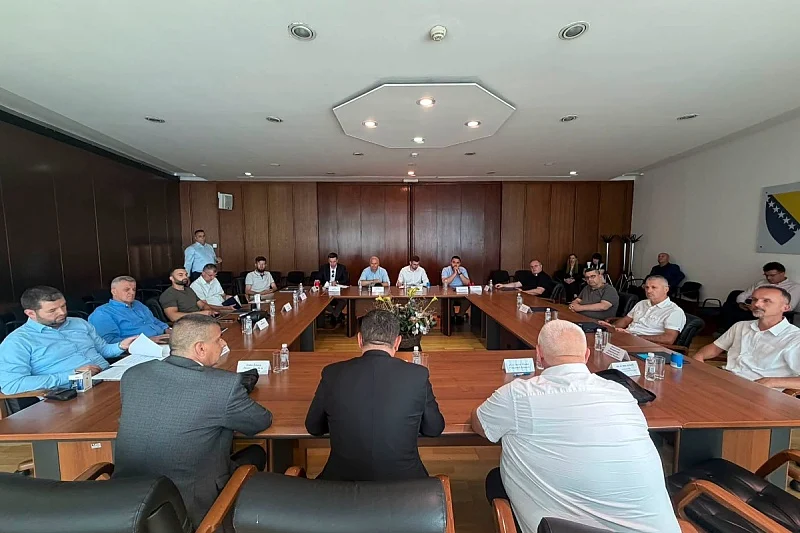
In the building of the Parliamentary Assembly of Bosnia and Herzegovina, a ceremonial signing of the agreement on the implementation of projects with representatives of churches and religious communities in Bosnia and Herzegovina took place.
The agreements were signed by the Minister for Human Rights and Refugees of Bosnia and Herzegovina Sevlid Hurtić, the President of the Commission for Refugees and Displaced Persons of Bosnia and Herzegovina Davor Čordaš and the Director of the Fund for the Return of Bosnia and Herzegovina Srđan Šekara, together with representatives of the Islamic Community, the Catholic Church and the Serbian Orthodox Church in Bosnia and Herzegovina.
On this occasion, agreements were signed for the realization of 18 projects with a total value of 771,000 KM, which will contribute to the restoration, reconstruction and improvement of the infrastructure of religious buildings and related contents throughout Bosnia and Herzegovina.
As announced by the Ministry of Human Rights and Refugees, the projects aim to improve living conditions in local communities, preserve cultural and religious heritage, strengthen mutual trust and create better conditions for sustainable return.
Minister Hurtić pointed out that the Ministry continues to consistently implement a policy of support for all peoples and citizens of Bosnia and Herzegovina through projects that connect people and contribute to the development of local communities.
“By signing the agreement today, we confirm that the institutions of Bosnia and Herzegovina continue to provide support for projects that have real significance for people. Religious buildings are not only places of prayer, but also spaces for gathering, solidarity and preserving the identity of local communities. Our goal is to contribute to the restoration of trust, the strengthening of mutual respect and the creation of better conditions for the lives of all citizens, especially in returnee communities, through projects like this. I am pleased that today we jointly invest in projects that connect people and send the message that diversity is the wealth of Bosnia and Herzegovina.” he ordered.
President of the Commission for Refugees and Displaced Persons of Bosnia and Herzegovina, Davor Čordaš, emphasized that such projects are of particular importance for environments where returnees face numerous challenges every day.
“The Commission for Refugees and Displaced Persons of Bosnia and Herzegovina continuously supports projects that have long-term significance for the sustainable return and development of local communities. These projects are not only important because of the restoration of buildings, but because of the sense of security and belonging they provide to people. When we jointly invest in the restoration of religious and cultural heritage, we also invest in mutual trust, dialogue and a more stable future of Bosnia and Herzegovina,” said Čordaš.
Director of the Fund for the Return of Bosnia and Herzegovina, Srđan Šekara, pointed out that the Fund remains a reliable partner in the implementation of projects that have a concrete impact on the lives of local communities.
“The Fund for the Return of Bosnia and Herzegovina continues to be a reliable partner in the implementation of projects that leave visible results on the ground. Each successfully implemented project contributes to a better quality of life for citizens and the strengthening of local communities. It is especially important that today’s agreements include projects of all traditional churches and religious communities, thereby confirming the commitment to equal access, mutual respect and joint development of Bosnia and Herzegovina,” said Šekara.
The signed agreements include projects that will be implemented by representatives of the Islamic community, the Catholic Church and the Serbian Orthodox Church in Bosnia and Herzegovina, confirming the commitment of the institutions of Bosnia and Herzegovina to contribute to the preservation of cultural and historical heritage, inter-religious dialogue and sustainable return in all parts of the country through equal support to all religious communities, writes Klix.


