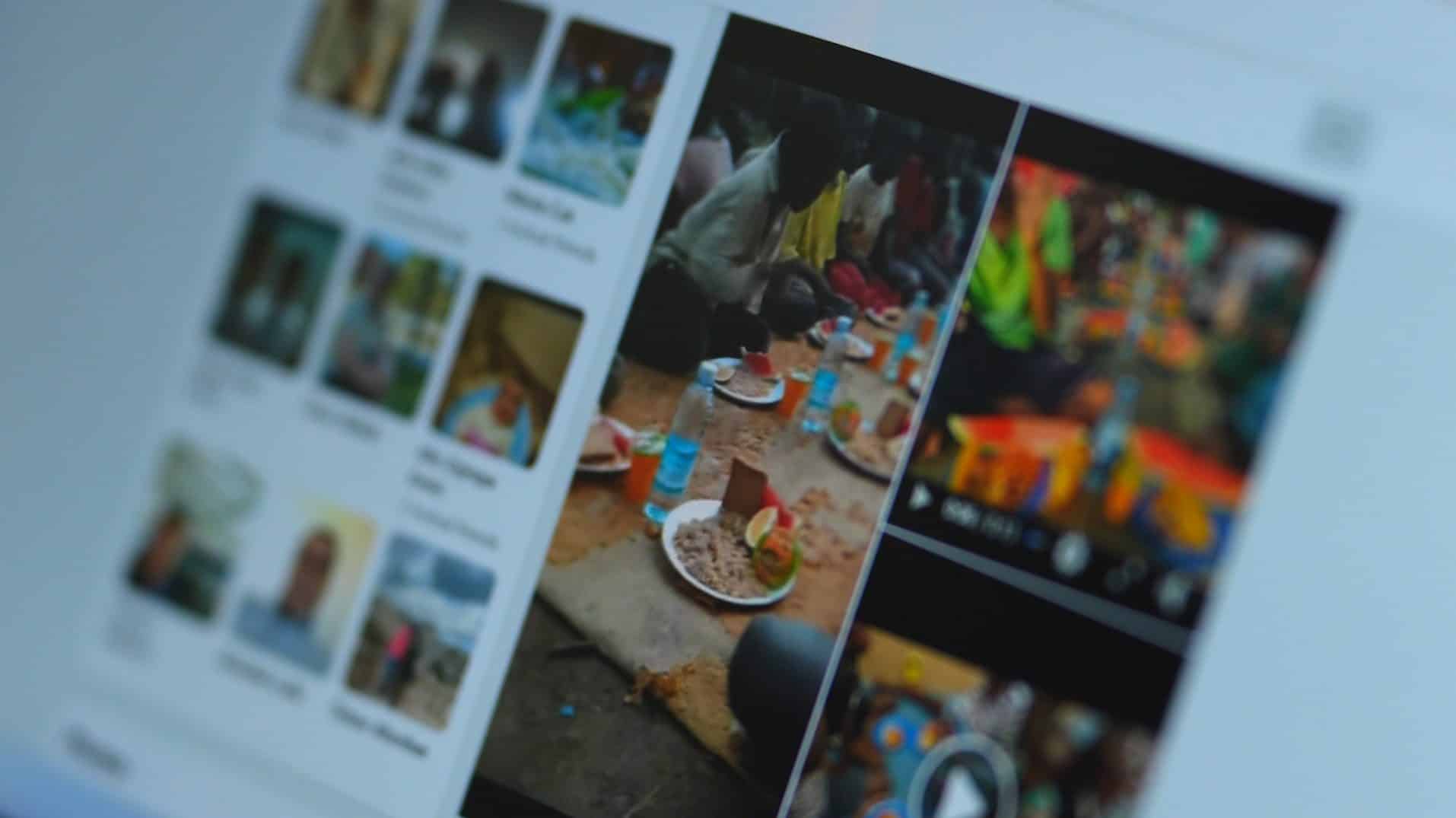
During the month of Ramadan this year, we found dozens of fake organizations and individuals from Uganda who invited people from Bosnia and Herzegovina and the diaspora to pay money for supposed iftars for hungry children in Africa. Using photos, fake profiles and names of other humanitarian organizations, they made money from people who thought they were doing good.
It was the first days of the month of Ramadan this year when Ramiz Alić, a pensioner from Srebrenik, had the best intention – to feed poor children without parents from Uganda in Africa.
On the social network Facebook, he meets a young man from Uganda who contacts him in private messages asking him to send him money to buy iftars for children. He told him that they were orphaned children and that he would not have lunch that day unless he sent the money. The young man was adamant that he needed the money urgently.
“Those children are orphans, without a father and a mother, it’s hard for me to talk about it when I see the photos of those children, I feel sorry for those children. I halal that money and have halaled it,” said Ramiz to the Detektor team.
The agreement was – 50 meals for fifty hungry children. The young man demanded that the money be paid to him through “Western Union”, a service for quick money transfers.
He is Magololo Ramadhan, a 21-year-old from Uganda who assured people that he was working for a humanitarian organization and that everything was going according to plan.
“How much is it? He says, one euro, one child. Come on, I’ll pay for 50, and that’s it. It was Saturday. Sunday, he calls: ‘Brother’, sends a message, ‘Brother, I’m waiting for your iftar.’ They said, brother, it’s Sunday today, I’ll go on Monday, there’s no bank today, they don’t work here. And so, on Monday, I went to the Western Union bank, paid 100 marks,” Ramiz tells us.
He deposited the money at nine o’clock in the morning, and Magololo picked it up a few minutes later. The agreement was to send Ramiz photos and videos of the children at iftar, as well as written names of him and his wife on the boards that the children will hold, and especially a board with the surname Alić for his son and his wife.
However, after the payment, the young man asked for more money, and for Ramiz to collect the additional amount through friends and acquaintances, which he did not do.
Magololo is found under another name on Facebook – Jumma Bin Shabhnu. After that, we switch the conversation to WhatsApp. As the days passed, Magololo became more impatient and insisted on sending the money.
Several times a day, he wrote sweetly worded messages using as much Islamic terminology as possible in the Bosnian language.
In the middle of Ramadan, we call him by video call, and the young man answers. He says he uses a translation app and works for the Juma Islamic Charity Organization. Soon he sends us a fake registration confirmation.
One child, one euro, was an offer for us as well.
“You can send money via ‘Western Union’, ‘Moneygram’, ‘Ria’, and I have my own organization, as well as another organization that I cooperate with,” Magololo convinced us.
Mirnela Salihović is the director of the Association “Connecting Bridges” from Sarajevo and for the last year she has been collaborating with organizations and individuals from Africa to collect donations. He also cooperates with organizations from Uganda and says that there is a special procedure so that the money should reach the right addresses.
She says that she received requests for messages from various individuals and fake organizations, but due to previous experience, she did not pay any money. For Detector explains the procedure for sending money.
“The name of the organization, when it was registered, when they got the seal, when they were founded. That’s the invoice that I get after payment. Of course, without those invoices that I don’t get – that means I don’t work, nor have I ever had a situation to work like that,” explains Salihović.
Most of the alleged humanitarians are journalists detector, and to the people from whom they asked for money, they asked for payments directly to their names, and in return they promised that the children would have the names of those who paid written on the boards.
Their profiles also include invitations to donate money for digging wells, and Detector previously revealed that individuals and associations from Bosnia and Herzegovina with the support of Salafi lecturers, collected several million marks for the construction of wells and mosques in Africa. The research showed that the money was collected in a non-transparent manner, and that citizens were provided with photos of allegedly constructed wells. We discovered that some of those photos were photoshopped.
Pius Enywaru, an investigative journalist from Uganda, says that he recently encountered similar cases – especially during the month of Ramadan – on Facebook, WhatsApp and TikTok. Fraudsters do not only target Muslims, but all people who want to donate money.
“They use well-known organizations that are relevant and trusted by people. They use famous people from different countries. They use their pictures, their social networks, they also publish their pages to make them look more authentic. We saw that the police did not pay so much attention. We had the opportunity to see initiatives that appeared in our government, which warned people not to fall for scams, and also some media organizations ran campaigns,” he explains to Detector.
Rashid Krupalija from the editorial office Disclosureswhich deals with verifying the veracity of content on social networks, says that fake calls for humanitarian actions are mostly placed on Facebook and YouTube.
“Meta” did not answer the question Detector about the removal of such content, even though such content is already known to violate community rules, and should be removed as such.
“What we have somehow seen is that such contents are rarely removed, with various excuses, that they do not violate the rules of the community, that it is not about contents that are harmful and similar, and somewhere such justifications pass because it is very difficult to prove that something is a fraud. It is very difficult to get in touch with ‘Meta’ and explain to the people who work there that something is obviously a fraud or that it is harmful content”, explains Krupalija.
In one of the messages he received DetectorFeki Ismail claimed that he works for the organization Muslim Relief and that his brother is the director of the organization. Fake e-mail the organization’s address and number exposed him, and Muslim Relief is not active in Uganda although there are fake profiles with that name. Media and watchdog organizations have warned about false collection of money for the poor in Africa, and the humanitarian organization Islamic Relief has already stated several times that several organizations and individuals using their logo in Uganda have appeared on social networks. Earlier, the US Embassy in Uganda warned about different types of internet scams.
Vahidin Đaltur, an information technology expert, believes that fraud occurs because users of social networks pay the most attention to the visual part, and not to the essence or accuracy of the content.
“Considering the funds that are collected in this way, because the Internet has literally set up such an organization to collect all over the world. These pictures also go to them in German, because you have a large population of Muslims, and in Turkish and Iranian and in Swedish, so it doesn’t matter,” explains Đaltur.
Detector found that people from Uganda sometimes used two names and multiple profiles. Nasser Manyuka asked for money from the profile of Ammad bih Nasser, but after detailed monitoring and comparison of photos, videos and phone numbers, we concluded that it is the same person. In the messages he still sends us, he is often sweet-talking and, using religious terminology, trying to extract money. People with at least 20 other profiles also spoke in a similar pattern, insisting on payments and calling for video calls multiple times.
Saša Petrović, the head of the department for combating computer crime of the FUP, says that internet frauds of this or similar types are under the jurisdiction of the cantonal MUPs. He says that he does not see the interest of those who should deal with it, but most cases or cases are transferred to the Federal Police Administration (FUP).
“It burdens us, extremely burdens us, that we can’t deal with the things we should be dealing with. Such a fraud, one request to ‘Meta’, who advertised through ‘Meta’, IP address, location, act according to that country, I would say roughly, in three or four steps to finish it,” says Petrović.
In addition to individuals, experts warn, the money can also end up with terrorist organizations, which is a criminal offense for those who pay.
“It is much easier for me to send five stamps than to investigate whether it is really so, my soul will be at peace, I helped someone, and it may actually happen that I got myself into trouble because I helped a terrorist organization, that is, financed a terrorist organization, which is a much bigger problem,” explains Đaltur.
(TYPE/Source: Detektor.ba/Author: Nino Bilajac/Photo: Detektor)