One will call the dismissal of Nenad Bjelica “chaos in Maksimir”, while others will say that “it’s never too late to make good moves”.
Time will show who was right, although there is no doubt that Dinamo’s leaders had a number of reasons for Bjelica’s dismissal. Just as it is not in doubt that he was not dismissed only because of “bad results in SHNL”. The last game – and a winning one at that – he played last Sunday. No one needs seven days to understand how 16 points won in 11 rounds is dramatically bad for a club that primarily wants to win the league title.
Bjelica was actually dismissed for three reasons.
1. He insisted that in the transitional period bring the players he chooses.
2. He’s not one of those coaches who likes to “push” young players.
3. Bad results in the league.
Bad results and small minutes played by young players are facts, easily proven mathematically. Although, Bjelica can always say that he would push Dinamo’s young players if they had the necessary qualityand that he wasn’t the one who filled the locker room this summer with numerous players, as a rule foreigners, to whom he himself had to give a chance, so there was no room for pushing the youngsters.
A handful of experienced players in the dressing room can be a good alibi for him, although we have been following his work in the first term in Dinamo, and after that, they clearly saw in Osijek that he prefers to send proven players to the fieldrather than taking risks with the younger ones.
However, Dinamo’s leaders had to be aware of this before they returned him to Maksimir at the end of September. They probably were – among other things, that’s why it wasn’t their first, or even second choice – but at that time, the prevailing view was that with Bjelica, they have a guarantee of a good result, as well as a coach who is extremely respected by the experienced players in the locker room.
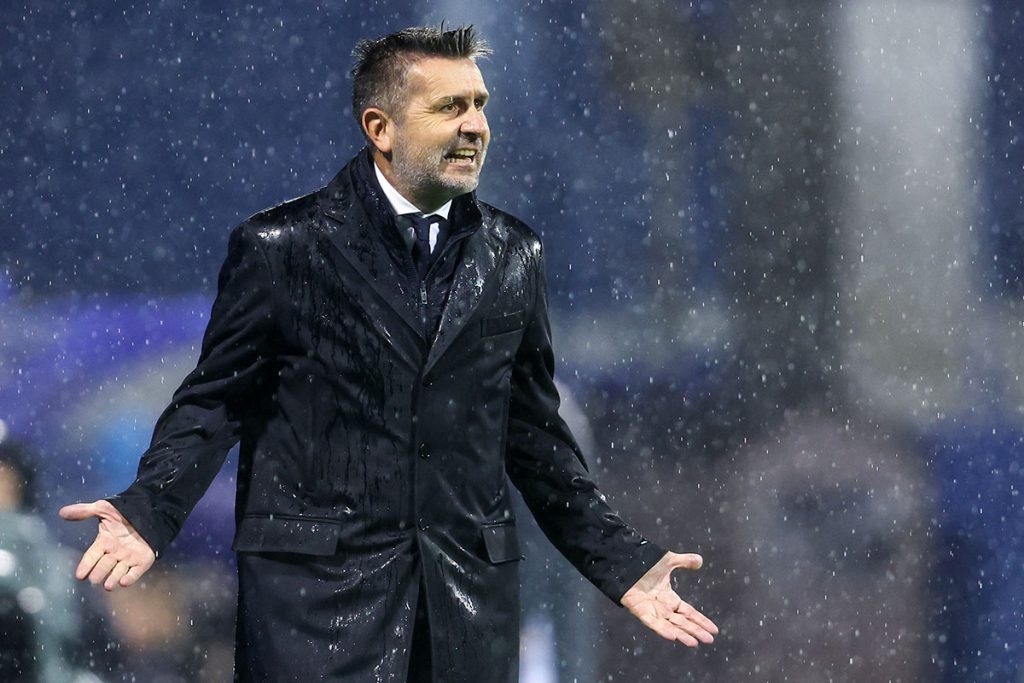
Photo: Luka Stanzl/Pixsell
At the time of bringing in Bjelica, it was too early to think about the winter transfer window in any way. A total of 16 games awaited Bjelica and the players. However, as the transition period in January approached, tensions grew as expectedand Bjelica presented them in his own style.
“There will be changes in the winter, and in my first term at Dinamo I showed what kind of players I value, and yes I prefer those who know our language“, he said Bjelica.
When we talk about Nenad Bjelica, it is important to know the following: After Dinamo, he signed a contract with Osijek that ensured him absolutely all football powers in the club. Both in terms of the first team and Osijek’s school, Robert Šola wrote for SN.
Bjelica had the right to bring whoever he wantedhe himself negotiated with the agents, agreed what the players’ salaries, compensation, or agents’ commissions would be. At the same time, he could write off whoever he wanted. Both in the dressing room and in the club. Only Nenad Bjelica had such powers in the history of our league. And we don’t believe that anyone will ever have them again.
Photo: Luka Stanzl/Pixsell
In the next two years, Bjelic brought maybe more than 30 players to Osijek, and the vast majority of them did not justify the huge financial investments. After Bjelica was fired (August 2022), the club struggled for a long time with the “reinforcements” left behind.
“In the mandate of Nenad Bjelica, we are on the transfers of players that he broughttheirs salaries and all the financial items that go with it, and he brought whoever he wanted, spent about 25 million eurosplayer salaries increased almost four times, and we invested more than 7 million in Bjelica and his staff alone! With the most expensive team and the most expensive coach in history we’re out from the European qualifications of semi-amateur from Kazakhstan.”
Those were words of the president of Osijek Ferenc Sakalja, who talked about how Bjelica brought the club into huge problems with his sports policy.
Bjelica is after Osijek got a job in Trabzonsporagain with great powers.
Before being fired, he only managed to lead 16 games therebut he met the summer transfer window in which, to the great surprise of even the Croatian public, he brought Tonij Teklić (Varaždin), Filip Benković (played in Bundesliga II) and Ognjen Bakić (Osijek). For those who may not know, Trabzonspor is a club that has a significantly larger budget than Dinamo.
Almost everyone he brought in (picked) turned out to be a bad move
He also brought Mislav Oršić – a player who had a reputation for such a club – who soon after his arrival seriously injured his knee. Mostly, none of four Croatian reinforcements left no trace in Trabzon. Teklić is today on loan in the Turkish second league Erzurumspor, Bakić in Šibenik, and Benković and Oršić they are currently without a club.
However, the people who run Dinamo never thought of giving Bjelica the powers he had in Osijek or Trabzon. The pattern of missed and costly reinforcements was too large to ignore. They agreed with him that reinforcements were needed, and that some players should be thanked, but they did not accept the idea that Bjelica would be the one to decide who would leave, and especially who would come. Dynamo doesn’t work like that, the club has a sports director and president Zajec, a management board, and an executive board.
And that cost Bjelic his job. If it was up to the results and minutes of the young players, they would have replaced him at the latest after the heavy defeat against Lokomotiva, and not a full two weeks later.
Bjelica is as far as we can tell thought that he could behave in Maksimir as he behaved in Osijek and Trabzon, and arrange the team in his own way, but he was mistaken. Dinamo leaders did not want to take such a risk.
With a reason…
Dinamo already made big transfers, here’s who’s coming
(www.jabuka.tv)