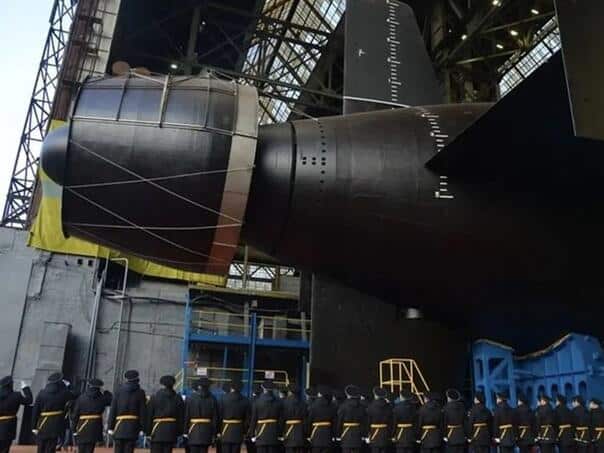
“Today is a big day for us – the heavy nuclear missile cruiser Khabarovsk was launched from the famous Sevmash shipyard,” Defense Minister Andrey Belousov said after Navy Commander Admiral Alexander Moiseyev broke a traditional bottle of champagne on the submarine’s hull, The Barents Observer writes.
The Russian Ministry of Defense confirmed on Telegram that the new submarine will carry robotic combat systems “for various purposes.” Khabarovsk’s main armament will be the Poseidon, a “doomsday weapon” the likes of which, according to Russia, has never been seen before.
It is an unmanned underwater vehicle in the form of a giant torpedo, which has its own nuclear reactor for propulsion and intercontinental range. It is armed with a thermonuclear warhead, and designed for a second strike, that is, for attacks on coastal targets across the Atlantic or Pacific. The information provided by the Russian side about this “doomsday weapon” has not been confirmed.
Russian President Vladimir Putin announced the development of this weapon back in 2018, and earlier this week he stated that the Poseidon had been successfully tested, including the activation of its reactor. It is assumed that the testing took place in the Kara Sea, east of the Nova Zemlya archipelago.
A completely new class of submarines
Very few details about the new submarine were known to the public before its launch on Saturday, although construction began back in July 2014. The Russian Navy classifies it as a “heavy missile cruiser,” but in reality it is an entirely new class of submarine. Instead of cruise or ballistic missiles, the Khabarovsk will carry up to six Poseidon nuclear megatorpedoes.
Photos from the ceremony released by the Sevmash Shipyard show only the rear of the submarine. The design of the aft part of the hull is similar to the Borei-A class submarines, and the partially covered propulsion system is also visible.
Defense Minister Belousov emphasized that the submarine “still has to go through a series of sea trials.” For new nuclear submarines, this process usually takes at least a year before the official handover to the Navy. Meanwhile, construction of another vessel of the same class, to be named Ulyanovsk, began in 2017, but it is not known when it is expected to be launched.
It is assumed that one of these submarines will serve in the Northern and the other in the Pacific fleet. The Poseidon drone development and testing program has so far used the modified Oscar-II class submarine Belgorod, the diesel-electric submarine Sarov and the surface vessels Akademik Aleksandrov and Zvezdočka.
(Vijesti.ba)