The total value of the reconstruction project was about 2.1 million KM, and fully funded by the General Directorate of the Republic of Turkey, through the Vacuation Directorate of the Islamic Community in BiH. Thanks to that, a colorful mosque known and named honorable, atik, city, and Behram-beg – returned to a shape reminiscent of her original look. The Restoration Protocol was signed in 2017. years, and the works began in 2018.
In addition to the Vacuation Directorate, works followed the experts of the Institute for the Protection of the BiH Monuments. Reconstruction was a distinctly complex and demanding process, from investigative works and design, all the way to the performance itself.
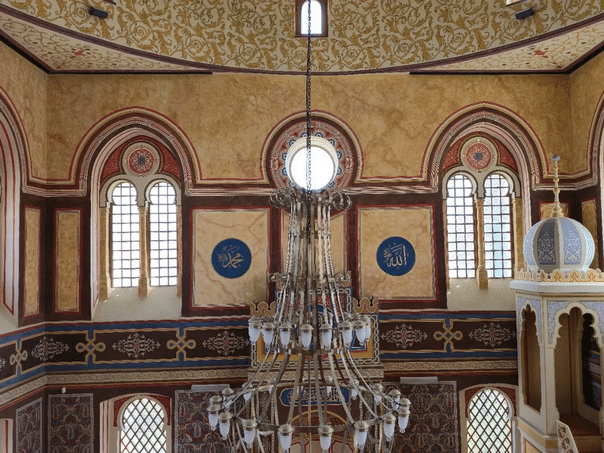
Today, the colorful mosque is adorned with the rich wall motifs, which, in addition to spiritual significance, leave a strong visual impression and reminded of the rich cultural and historical heritage.
The beautiful interior of Behram-beg’s mosque testifies to its exceptional artistic and architectural value.
The Senior Professional Associate for Vakufes in the Suzla Islamic Community Tuzla, Elmedin Avdibasic said that the relief and painted decoration is one of the main features of the pseudomourg style in the colorful mosque is among the most beautiful in BiH.
– The combination of traditional architecture and foreign influences has resulted in a unique architectural expression – he said.
All the aesthetic characteristics, including facade processing, openings, decorative elements such as serrated compartments and wreaths, and internal processing, are performed in a pseudomaur manner.
– One of the characteristics of Behram-beg a mosque reminiscent of the Maurish architecture are hindcoming arches above the window and on the porch. Such arcs are characteristic of Islamic Spain, while the beige-reddish facade in the form of lines is typical of the Momelučko era of medieval Cairo – explains Avdibašić.
The reconstruction project included a number of interventions: the air-like roof and the authentic domple, the renovation of the original decoration on minars and facades, constructive walls, interior imaging, as well as the arrangement of harems and outdoor space. The mosque dome now looks like the one from 1888. years.
– After damage to the wooden structure during removal of lead covers, the architect Franc Kuril is 1895. developed a project of adaptation according to which the original wooden dome was replaced by a four-footed roof. Wood sofas with a canopy were demolished in 1960. years, and instead of them were built new sofas with eight-mason pillars connected by bows, covered by a three-wide roof – he stated.
Investigative works and preparations for project development lasted for years. The main line of a fault of uneven and irregular soil shrug in the old part of the city passed just below the mosque, which was a special challenge for geologists and staffers, Avdibašić explained.
– The interior of the mosque is several times painted, and investigative works on painting decorations were performed in the restoration in order to determine the authentic appearance. The lack of archival material makes it difficult to make decisions on the dome and its decoration, but thanks to the expertise of numerous associates, all challenges were successfully overcome. The painting of the interior was performed according to the principles of the Venetian Charter of the new color are natural and shade brighter than the original – said Avdibašić.
The colorful mosque is located on a treasure exchanging in Atik Mahali in Tuzla. The first time is mentioned in 1548. years, and it is considered to be built after 1533. Vakuf The Honor (Atik) of the Mosque was created in the first half of the 16th century. Century. The mosque, together with madrasa and mekteb, burned in fire on 10. September 1871. years.
The mosque was designed by Franc Mihanović, while later adaptations were made according to Franco Kurila project. It is a rare and valuable example of architecture of that time, and its significance further increases authentic painted decoration, which – although partially covered – managed to preserve. Due to the two-color facade and richly painted interior, in the National Tradition, it is known as a colorful mosque, it was announced from the Vacuation Directorate from BiH.
(Vijesti.ba / Fena)