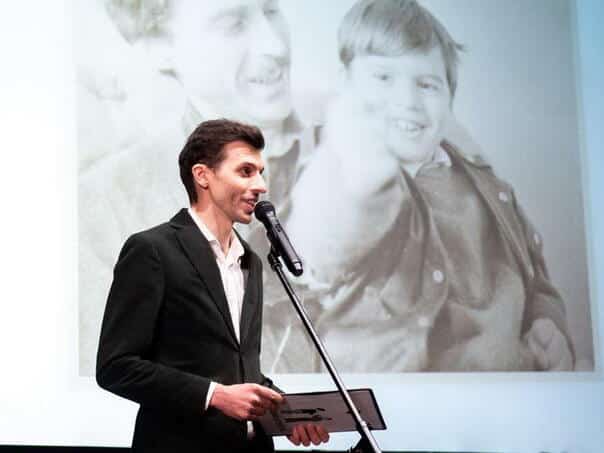
Satisfied with the results of work, they made a collection unique in the world with more than six thousand exhibits from twenty different wars. They work with schools and universities from BiH and the world, have an office in Kiev (Ukraine) and researchers around the world. The founder and General Manager of the Museum Jasminko Halilović says it is a result of long-term work, which lasts longer than eight years and before the museum is open.
– We made a collection that is unique in the world, more than six thousand exhibits from twenty different wars. It is the only place in the world where in one room you can see something from Ukraine, Palestine, Bosnia and Herzegovina, Thailand, Myanmar, and other countries. So in that sense, that collection becomes globally legacy, the cultural heritage of the world. We are proud of that work. It is the work that is always in progress, that collection continues to spread – said.
He hopes the museum, and in the years to come, continue to work and be a unique platform that advocates peace around the world. He believes that it is that the Museum of War Childhood is doing, without exaggeration, from historical importance.
– Not only our unique collection, but also a systemic contribution to the construction of permanent peace in BiH, in an environment in which it is still threatened with the war on a daily basis. Only this year we will train more than 250 educators and work with more than 15,000 children from more than 30 municipalities and cities. At the same time, more than 450 young people from 59 municipalities from the entire country apply to participate in our peace project that will result in 20 exhibitions throughout BiH – emphasizes Halilović.
He says that they are happy because the museum works with hundreds of schools and universities from BiH and the world and to become a place that, in some way, gathers educators, all who deal with peace education.
– We are satisfied that the museum of extensive international cooperation really expands its reach. However, it is especially important to us that we have teachers from all over Bosnia and Herzegovina that come to the museum, visit and use our materials in their classrooms. It is our contribution to peace education: how to use museum collections and exhibits for working with children in schools, teaching methodology based on cases or exhibits. We really pay a lot of attention to that, “he said.
According to Halilović, nowhere in the world is not easy to deal with the topic of the culture of memory.
– We have states where the wars are currently happening, where the museum is also trying to work, we have an office in Ukraine. We also have our researchers around the world, one researcher for us worked in Palestine. It is not easy to deal with that topic, but we believe it is important. We consider our collection unique and we will continue to do it. For young people, for children or people who used to be children that is a platform that allows them to tell their own stories to their words, to remember their children, to talk about their experiences. We believe it is extremely important – he said.
For the eighth birthday of the Museum of War Childhood, the exhibition of the works of Milomir Kovacevic was a terrible ‘children of war, people of peace’. At the Academy of Fine Arts in Sarajevo, in the period until 3. April, more than a hundred photographs were placed. These are the visual stories of children recorded during the war, with their portraits and as adults.
Halilović emphasizes that anyone who deals with the culture of memories in BiH or anywhere, must feel respect, honor and gratitude when he has the opportunity to work with someone as Milomir Kovacevic is terrible.
– His work, not only is crucial for the documentation of what happened in Sarajevo during the siege, but for me, it is personal to be a strong example of how the artist can fully deal with his city, how they can become inseparable. I think the destiny of Sarajevo is inseparable from the fate of Milomir Kovacevic and the opposite – he said.
The birthday of the museum this year dedicated to a war photo, and shared one of his black and white photography from the war period in Sarajevo on the birthday marking. By pointing out how much it means and how much he means to his family, he substinantly the importance of each war photo for individuals and society.
– I’m sure and I can understand how many photos Milomir Kovacevic mean to all these people and how much it means to their families, their friends. For some people, these are the only memories from that period. I think that’s proof of what photography as a medium and what an artist can do for his city. We’re really happy to work with Milomir, “he said.
Created on the basis of the book ‘Childhood in the War’, the Museum of War Childhood is the only world museum focused exclusively on childhood marked by war. Through this unique platform, the museum allows facing trauma and the past and individuals and communities, contributing to such a greater understanding in society.
The first permanent setting of the museum dates from January 2017. years. Already in 2018. The Museum was given the European Museum of the European Museum of the Year, and a year later received the Mercury Award in the election for the best Slavic Museum. In 2019, he was included among the 50 museums defined by the European Museum Scene in the last 40 years.
Today, the Museum is an international platform that has projects in several countries, and regulated in Sarajevo, Kiev and the Hague. Last year, the MRD exhibited for the first time outside Europe, and a large exhibition in Seoul in South Korea visited more than 200,000 people.
Jasminko Halilović was born in 1988. in Sarajevo. Before he fully devoted himself to the establishment of his non-profit initiative, the Museum of War Childhood, engaged in entrepreneurship. He also published several books including the ‘childhood in the war’, which was translated into six languages. As a guest lecturer, he spoke at universities and conferences in more than twenty countries. In 2018, he became the first Bosnian chosen to Forbes ‘European list of young leaders ’30 below 30’, and 2023 was named European young leader (EYL40).
(Vijesti.ba / Fena)