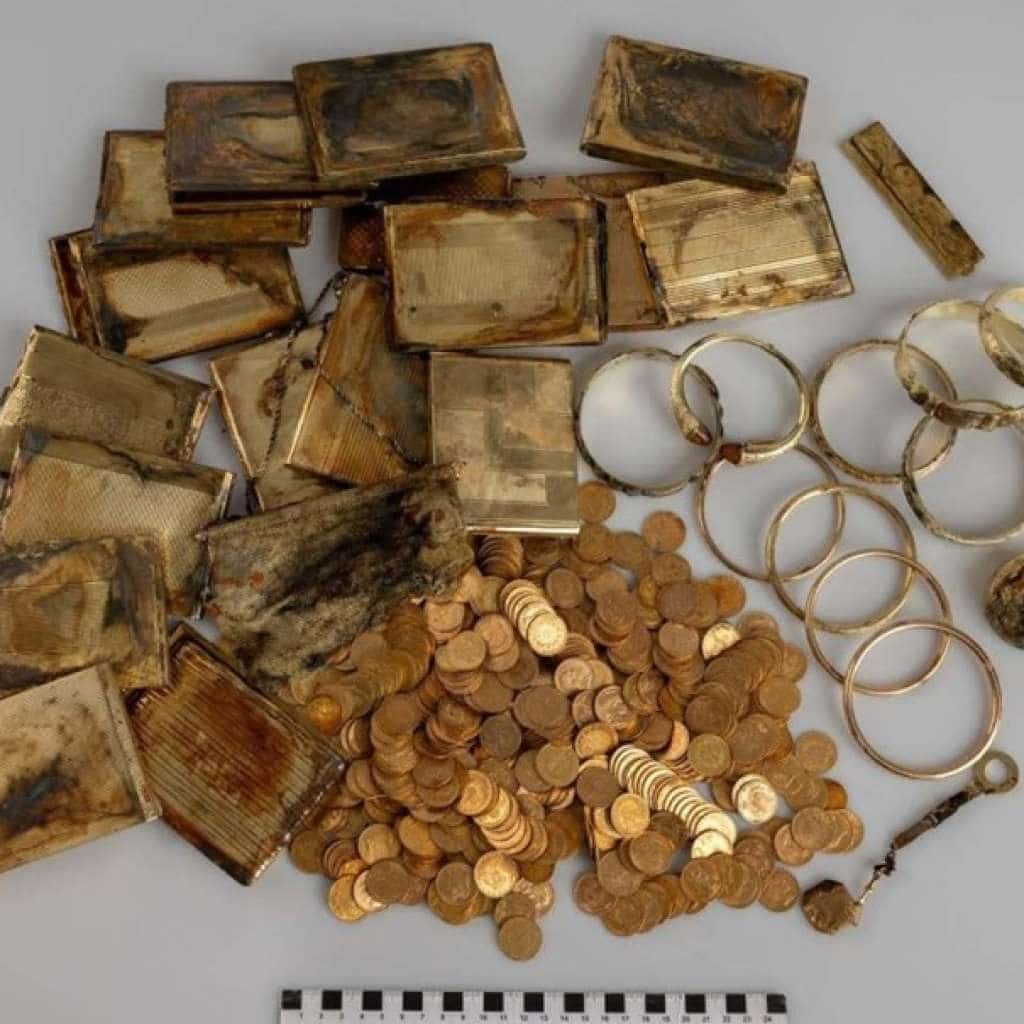
The two hikers walking southwestern slopes of the hill of Zvikina in the eastern Czech Republic, the right of the hidden treasure. In two metal boxes, buried inside the stone mound, they found two metal boxes with almost seven pounds of valuables – including about four kilograms of gold coins leading to the Kingdom of Yugoslavia.
The mountaineers found almost seven kilograms of valuables in two metal boxes – including about four pounds of gold coins, the Jutarnji list is transmitted.
The first box contained 598 carefully complex gold coins, while in the second, yellow metal objects were found: bracelets, comb, chain, purse and powder.
According to some theories, the new light on the dark chapter of European history would take over the Museum of East Czech Republic in Hradac Králové, which is through social networks and reported on that great discovery.
According to Miroslav Novák, the head of the Museum Archaeological Department, it is a unique finding.
“Storing valuable items in the land in the shape of a treasure, the so-called Practice is more common. They were mostly on the intention of returning to the unusually great severity of the noble metal,” the museum leader emphasized.
“In the case of coins, a collection cannot be estimated as the ordinary currency of that period, but primarily as a slightly noble metal” considered the Numismatician Museum of Eastern Czech Republic to Hradec Králové, Vojtěch Brádle.
He added that the slightly lay hidden in the country a little over a hundred years and that coins were forged in the former Yugoslavia during the 1920s and 1930s.
The slightly lay hidden in the country a little more than a hundred years. According to the forging dates, it contains coins from year 1808. until 1915. In this particular case, however, years 1915. is not decisive to determine the time when the depot was created. The reason is the presence of several pieces with miniature markings, the so-called Contramarks, which could be secured only after the First World War.
The coins are forged in the former Yugoslavia during the 1920s and 1930s. It can be said that this is a very specific collection in its composition within domestic findings, because most of the French origin coins, and the BELGIAN and Ottoman coins in larger quantities in larger quantities. German and Czechoslovak coins are completely missing.
Special intrigues the origin of the part of the gold coins. Namely, among the coins from the Austro-Hungarian period are those with the markings that indicate that they were intended for the markets of Serbia and Bosnia and Herzegovina. It is speculated that from the period of the Kingdom of Yugoslavia.
The value of the found treasure could exceed 7.5 million Czech crowns, but the right value may be hidden in its origin and historical context.
Experts in the eastern Czech Museum still try to figure out the circumstances that led to burying the treasures at this location. As the Numismatician of the arms of Bradle coins came from Serbia and BiH, but as they reached the Czech Republic remains unknown.
Several theories: that they hid the Czech citizens who were run away from the Nazi occupation after 1938. years, to the assumption that they could have slightly hide the Germans by expecting expulsion after World War II. No theory is excluded, which indicates communist monetary reforms from 1953. as a potential catalyst for hiding.
(Type / Source: FENA / photo: Jutarnji list / Muzeum Východních Čech v Hradci Králové)