The whole atmosphere was completed with a musical program in which Vlado Podany and Tin Tomić performed.
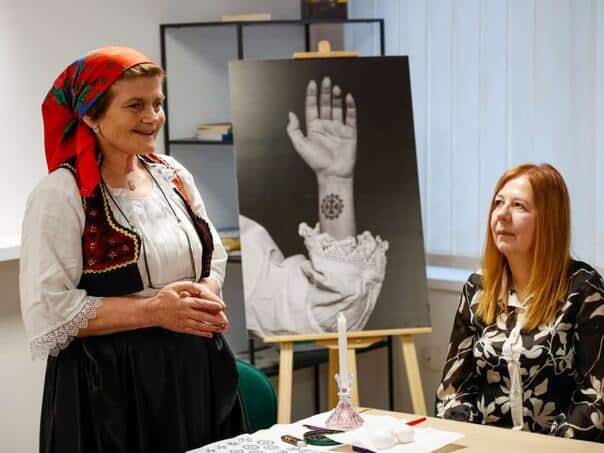
Federal Minister of Culture and Sports Sanja Vlaisavljević said that in this beautiful week, they organized two activities today – one is an exhibition of Catholic women’s tattoos, and the other is Easter egg coloring, an old beautiful tradition of coloring in wax.
She expressed the hope that the participants of the workshop will take away beautiful memories and that they will learn how to do it in the traditional way.
– There is not a single community that does not rest on tradition. If we forget the tradition, we have forgotten the community, the identity, and then in that sense we lose what we are, whatever community it is, what belongs to the community, and by remembering, reminding and reviving the tradition, we are actually reviving the spirit of being of that community – said Vlaisavljević.
One of the authors of the “Identity” photo exhibition, Irena Mrnjavac, said that she comes from central Bosnia and has traditional tattoos, like her grandmothers had.
– I had the desire to, in some way, honor the grandmothers who are getting older and there are very few of them, but also to somehow connect that tradition with today’s modern way of tattooing, but to the women who really continue that tradition – said Mrnjavac.
She pointed out that it is important to continue every tradition, of any nation, of any climate.
The president of the Croatian cultural society Napredak – Kreševo branch, Marija Pervan, said that two members of the society showed the participants of the Easter egg decorating workshop how eggs were colored before Easter a hundred years ago and more.
She explained that it was done with wax and with simple motifs, which in most cases were also tattooed on the hands of their grandmothers using the sicing technique. She stated that the type of tattoo their grandmothers had was called a sizzling.
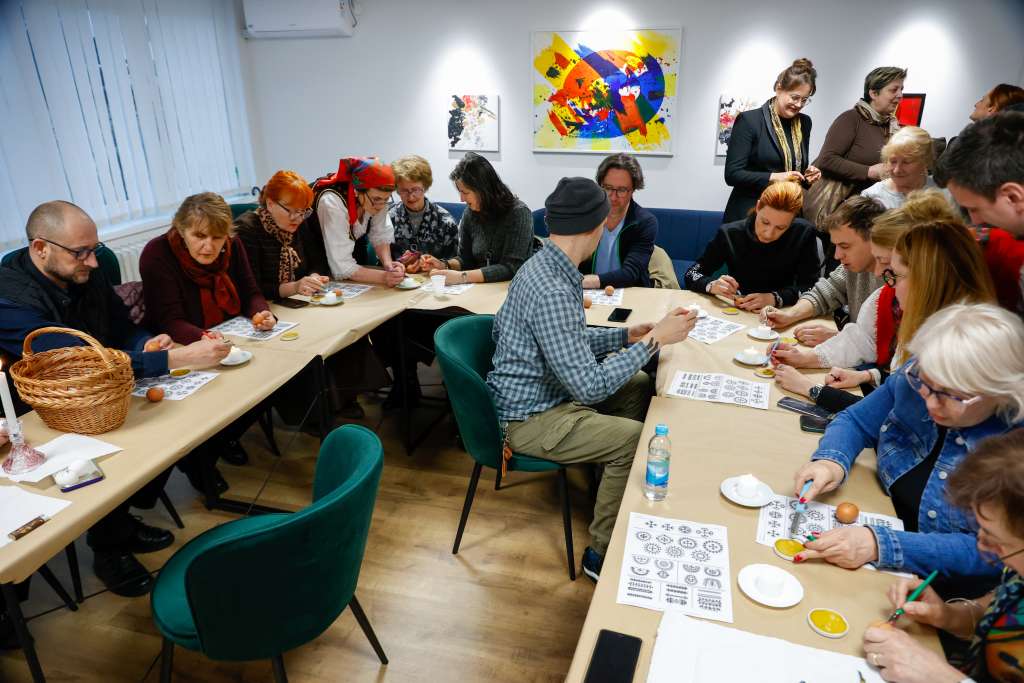
According to her, the motifs that were on their hands, necks and other parts of the body were mostly also on the eggs that are painted before Easter.
– Eggs were painted with wax, and then onion peel or some other natural material was used for painting after painting with wax. That’s what we came to show today – said Pervan.
She added that the traditional painting of eggs with wax has been preserved in smaller towns much more than in larger cities.
– Our municipality of Kreševo is one of the smaller municipalities, but we have preserved a good part of that tradition, not only related to egg painting, but also in general – said Pervan.
(Vijesti.ba / FENA)