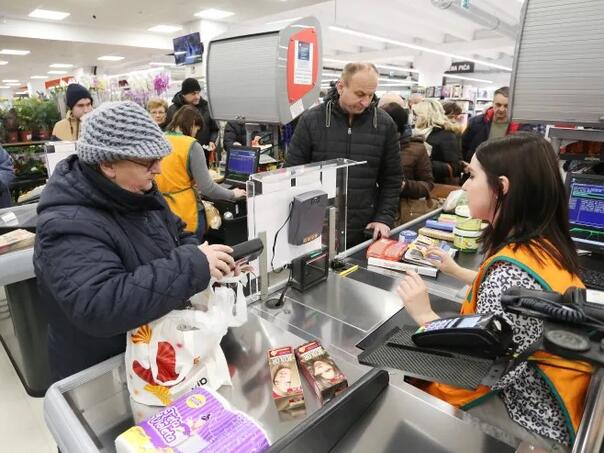
According to ECSR, the lifestyle crisis has negatively affected the rights guaranteed by the European Social Charter, leading to inadequate social protection, reduction in real minimum wages, inaccessible housing, energy poverty and food supply.
It is further stated that inflation and growth in the prices of basic living needs significantly exacerbated the living standards of millions across Europe, and women, children, older people, low-income households and people with disabilities.
ECSR warns that temporary and disposable measures are, which are numerous countries have taken, insufficient for long-term protection against poverty and social exclusion.
Bosnia and Herzegovina in Report
Among the countries covered by the report, there is also Bosnia and Herzegovina, which recognized the need for emergency social interventions. In the context of economic challenges caused by the Coronavirus Pandemium and the growth of lifespan, in late 2022. 100 km (50.8 euros) were paid in 187,247 unemployed persons.
Similar measures were conducted by other European countries. Austria paid out three disposable unemployment benefits, Croatia pensioners up to 160 euros support, and Montenegro, Serbia, Greece, Moldova and the United Kingdom have also provided similar payments.
Special attention was also focused on children and vulnerable groups. In the Czech Republic, children from poorer families received 5,000 CZK (198 euros), while in Ireland received their child benefits. France, Portugal, Cyprus, Norway and the United Kingdom provided assistance for low-income persons and disabled people.
When it comes to BiH, Republika Srpska introduced measures to support families with several members, including unemployed benefits with four and more children. This measure was recognized as a significant step forward in support of multi-member families. Also, a children’s allowance increased, and the fees for parents caregivers increased from 25 to 100 percent of the base. The number of users of this fee in 2022. year increased by 44.67 percent compared to 2020. year.
The European Committee for Social Rights is recalled that states have the obligation to regularly harmonize social benefits with the growth of living costs to protect the standard of citizens.
The report notes that the system of harmonization of social benefits and pensions in BiH differs from standard European models related to consumer prices or salaries. In the Federation of BiH, pensions are harmonized every year 15. April, and the amount of harmonization is determined according to GDP and inflation. Thus, in 2023. year pensions increased by 11.1 percent in January, then by 5.15 percent in April and extraordinary by 3.9 percent in May.
As for the minimum wages in BiH, the regulation system differs between the entities. At the time of writing the report, there was no law in the Federation of BiH that directly defines the minimum wage. It is stated that it is determined according to collective agreements and employment acts, with annual harmonization according to the consumer price index.
In the Republika Srpska, the minimum wage is determined by the government towards economic indicators and inflation, and in the period from 2021. until 2023. year increased from 520 km (265 euros) to 630 km (322 euros).
Serious consequences
The main director of human rights and the rule of law Gianluca Esposito assessed the report by one of the most important this year because it is directly concerned with many people.
– The lifestyle crisis affects millions of people across Europe and should concern all of us – the Esposito warned, adding that for the Council of Europe, social and human rights are equally important as civil and political.
He especially emphasized that housing, food and transportation are three basic living needs that experienced the largest increase in prices, while salaries were mostly remaining the same, which is why people are literally struggling to survive by the end of the month.
The President of the ECSR Aoife Nolan explained that the lifestyle crisis was elected for the first horizontal inspection because they are just paying, housing and health care for the core of the European Social Charter.
From the European perspective, it explained that at the beginning of 2022. the Russian invasion of Ukraine began and that experts warned about the coming of the great inflationary crisis until the summer. According to nolan, the cause, were disorders in supply and jumping prices of food, fuel and energy.
– The conflict exacerbated all this, although the prices grew before the war. By the summer of 2022. Europe really faced the crisis because the costs of basic living needs grew much faster than the average household income – Nolan said.
He adds that they were not all equally affected by the crisis. As in each second crisis, pandemic, financial or climatic, those who have already been killed on the social margin, stated Nolan. According to the report, four most vulnerable groups are especially emphasized, and low-income households, children and young people, people with disabilities and an older person.
ECSR vice president Tatiana Puiu emphasized that social protection is the foundation of the European Social Charter and that growth in price without compensation measures leads to a reduction in social rights and social exclusion.
– Although states have increased social benefits, and measures were often temporary, while the crisis lasted longer. On the other hand, we also saw examples of reducing social benefits or freezing alignment due to ‘fiscal sustainability’ – warned Pui.
The Vice President of the European Committee for Social Rights George Theodosis has referred to the impact of the crisis on working rights, emphasizing the record decline in real salaries in Europe.
– We recorded that the worst paid workers in Europe in 2022. recorded a decline in salaries of approximately 19 percent, which is a record drop. As a consequence, many employees who have received the minimum wage were actually receiving an amount that did not reach a national net average salary, which is the standard that the European Social Charter to ensure a dignified standard – said theodosis.
He pointed out that some countries, such as France and Belgium, introduced automatic harmonization of information with inflation, but in many countries the minimum salary still does not reach a standard of 60 percent of the national net average salary.
The main rapporteur of Kristina Dupate warned of a strong impact crisis to the right to live.
– Housing costs are the largest expenditure in home budgets, and during the crisis of the cost of life, the costs of other basic needs have increased. This further affected the possibility of households to settle housing costs. The housing crisis is actually present in decades. Housing costs are constantly growing, while income is not accompanied by that growth – it emphasized the drupata.
She pointed out that the examples of good measures are the increase in housing benefits, the revision of minimum revenues needed to achieve the right to housing compensation, disposable payments, repay mortgages and the introduction of rental growth restrictions.
– Unfortunately, because of economic problems, some states stopped the construction of social apartments, some did not increase housing benefits, and some even reduced housing fees – she warned.
Recommendations for future action
Representatives of the European Committee for the Social Rights of the Council of Europe recommend the introduction of permanent social protection measures, regular harmonization of social benefits and minimum salaries with the costs of life and strengthening collective bargaining and social housing.
This report gives clear guidelines that countries must do, not only now, but also in future crises, it was concluded on the presentation of the report.
(Vijesti.ba / Fena)