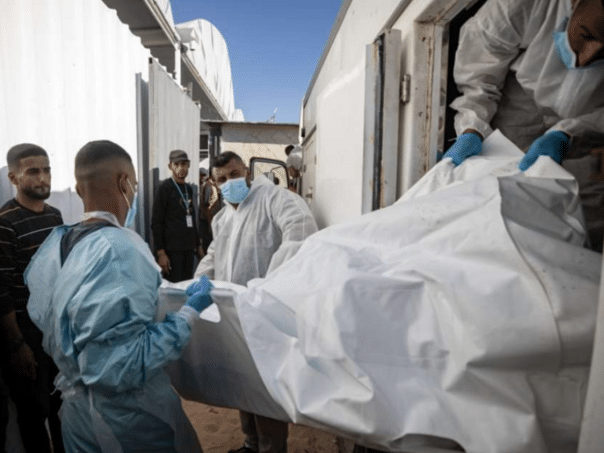
From a single room, without its own DNA analysis capacity or cold storage, the forensic team at Gaza’s Nasser Hospital faces the challenges that peace brings.
Over the past eleven days, Israeli authorities have returned 195 bodies to Gaza in exchange for the bodies of 13 Israeli hostages, under the terms of a cease-fire deal negotiated by United States President Donald Trump.
Photos released by medical authorities in Gaza show some bodies in a badly decomposed state, dressed in civilian clothes or naked except for underwear, with multiple injuries. Many have their hands tied behind their backs, and doctors claim that some bodies arrived blindfolded or with cloth wrapped around their necks, writes the BBC.
The forensics team at Nasser Hospital is working with almost no resources to answer questions about torture, abuse and identity.
Head of department, dr. Ahmed Dheir, said that one of the biggest problems is the lack of cold storage space. The bodies arrive completely frozen and take several days to thaw, making even basic identification methods like dental analysis impossible, let alone a deeper investigation or autopsy.
– The situation is extremely difficult. If we wait for the bodies to thaw, decomposition begins almost immediately, which puts us in an impossible position because we lose the ability to properly examine the remains. The best method is to take samples and document the condition of the body as it is – he said.
dr. Alaa al-Astal, a member of the forensics team at Nasser Hospital, said some of the bodies showed signs of torture, such as bruises and binding marks on the wrists and ankles.
– There were extremely terrible cases, where the binding was so tight that the blood circulation in the hands was interrupted, which led to tissue damage and clear traces of pressure – he said.
– Even around the eyes, when the blindfold was removed, deep grooves were visible – imagine how much force was required. The pressure left real marks where the bandage was tied – he stated.
dr. Astal also mentioned the loose cloths tied around the necks of some of the bodies as a subject for further investigation.
– In one case, there was a groove around the neck. To determine whether the death occurred due to hanging or strangulation, we needed an autopsy, but the body was frozen and not dissected – he said.
Sameh Yassin Hamad, a member of the Hamas-led government committee in charge of receiving the bodies, said bruises and blood seepage were visible indicating the bodies had been severely beaten before death. He also said some had stab wounds to the chest and face. Some of the photos clearly show deep gouges or tightly tied plastic laces on hands and ankles. One photo shows bruises and scratches that confirm the laces were used while the person was alive.
Other bodies show only deep binding marks, meaning an autopsy would be required to determine whether the bindings were used before or after death. Plastic ties are sometimes used to transport bodies in Israel. When asked about the evidence collected, the Israeli army replied that it acts strictly in accordance with international law.
The photos were shown to outside forensic experts and represent only a portion of the bodies that the Red Cross transported to Gaza. All three experts said some features raise questions about what happened, but that without an autopsy, it’s difficult to draw firm conclusions about abuse or torture.
– What is happening in Gaza has the characteristics of “international forensic urgency”. Based on these photos, there is an urgent need for full medical autopsies. We need to know the truth about how the deaths occurred, and the only way to find out is an autopsy – said Michael Pollanen, a forensic pathologist and professor at the University of Toronto.
Despite limited data, doctors at Nasser Hospital say the routine tying of the hands behind the back, along with marks on the limbs, indicate torture.
– When a person is naked, with their hands tied behind their back, and visible traces of binding on their ankles, it indicates that they died in that position. It is a violation of international law – said dr. Dheir.
There is strong evidence indicating widespread abuse of prisoners, including civilians, in Israeli custody in the months following the start of the war in October 2023, particularly at the Sde Teiman military facility.
– At least in the first eight months of the war, prisoners from Gaza were tied behind their backs and had their eyes covered, 24 hours a day, 7 days a week, for months – said Naji Abbas, head of the Program for Prisoners and Detainees at the Israeli human rights organization Physicians for Human Rights (PHRI).
– We know that people have developed serious infections on their skin, hands and feet due to binding – he added.
Interviews with several people who worked at Sde Teiman over the past two years confirm that prisoners were tied by the hands and feet, even during medical procedures, including surgery. One medical worker who worked there said that he asked for the restraints to be loosened, and that the treatment of the detainees was dehumanizing.
One of the challenges for doctors at Nasser Hospital now is to determine which of the returned bodies belong to Hamas fighters killed in battle, which are civilians, and which are prisoners who died in Israeli custody. Some of the bodies returned from Israel still wear Hamas headbands or military boots, but doctors say most are either naked or in civilian clothes, making it difficult to determine their roles, interpret injuries and assess human rights violations.
(Vijesti.ba / FENA)