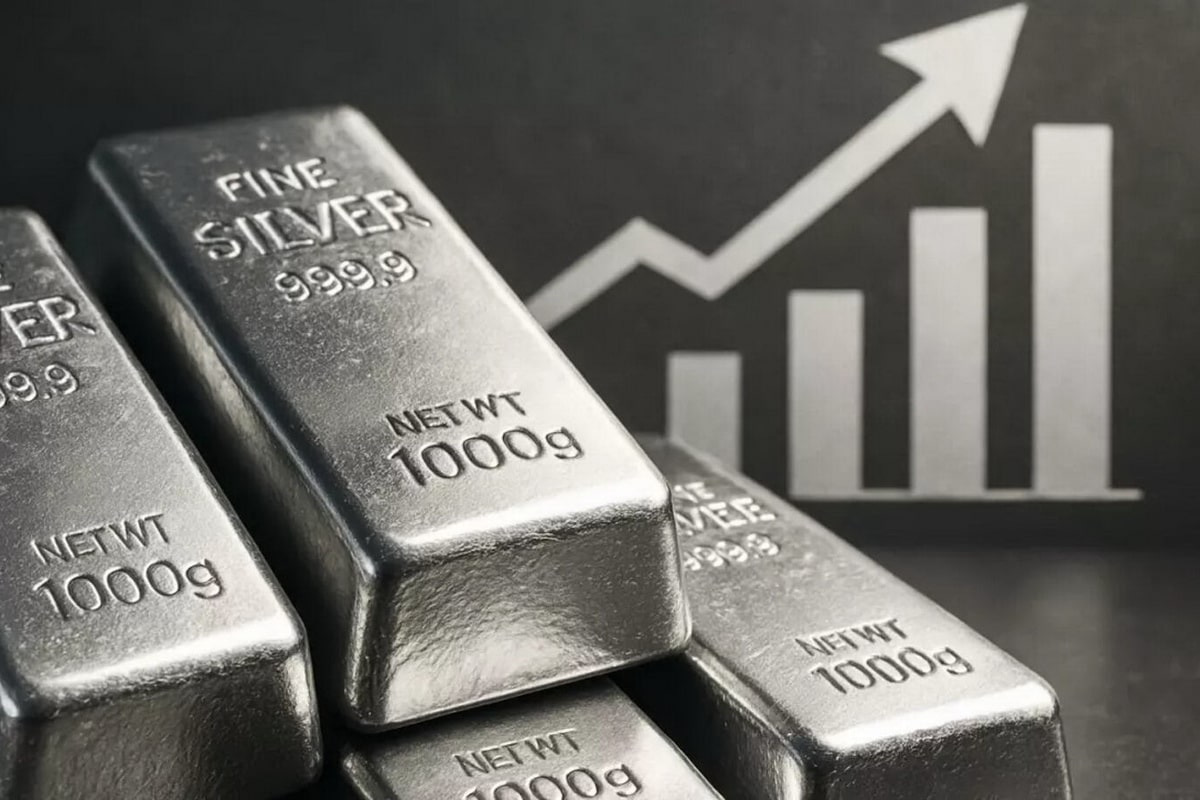
In these turbulent times, the hunt for precious metals has been going on for a long time, and now the price of silver has also exploded – it jumped by 270 percent in one year.
It is more than gold. What is the reason for this – and what are the future prospects?
This year too, records are falling in the precious metals market. This week, the price of gold broke through the psychological limit of $5,000, and now silver, for the first time in the history of trading, has exceeded around $100 per ounce, and is currently somewhere around $117.
Already last year, the hunt for both gold and silver began. The growth of their price has not been so high since 1979, and now the price of silver has literally skyrocketed: in 2025, the price of gold has increased by almost 65 percent, and silver by as much as 148 percent.
The growth continued this year: so far, the price of silver has increased by another 45 percent, and gold by 21 percent. According to HSBC analyst Jörg Scherer, silver is currently in a “remarkably dynamic uptrend”.
In both cases, metals benefit from their reputation as a “safe harbor” for investors. At a time of numerous geopolitical conflicts, an unpredictable US president and a strong decline in the value of the dollar, investors are happy to convert their money into gold and silver.
The industry is hungry for silver
For silver, there is another important driver of growth: industrial demand. Silver is no longer so important in photography because it practically doesn’t exist anymore, but there is its physical property of being the best conductor of electricity and heat. “The expansion of the solar industry in particular has strongly increased the demand for silver,” Sonja Marten, chief economist of DZ Bank, told ARD.
The global transition to renewable energy sources has made silver an indispensable raw material, primarily for photovoltaic cells where silver is still difficult to replace without losing efficiency.
But silver is not only used in the solar sector. It is also crucial in electromobility, electronics, high-tech production and communication technology, as well as for data centers, but also because of the rise of artificial intelligence.
Exploitation has its limits
On the other hand, world silver production cannot keep up with growing demand. The reason is that more than 70 percent of the world’s silver production is obtained as a by-product during the extraction of lead, zinc, copper and gold, while only about 30 percent comes from primary silver mines, reports SEEbiz. This limits the industry’s ability to quickly increase production in response to rising prices.
Stalls on the supply side further encourage price growth. Analysts are talking about a “structural supply shortfall” — which many see as a key element of the silver story. At the same time, this shortage gives the current price race a certain sustainability, which is an important difference compared to the purely speculative growth waves of the past.
Big investors like hedge funds are not the main drivers of this race in the price of silver. This is shown by the weekly “Commitment of Traders” (CoT) reports, which show the positioning of the most important participants in the American futures and futures markets.
Is silver too expensive now?
Silver speculation remains low, says market analyst Robert Rethfeld of Wellenreiter‑Invest. “According to CoT data, silver could continue to rise.”
A look at the ratio of gold and silver prices calls for caution, however. This ratio shows how many ounces of silver are needed to buy one ounce of gold. It is currently around 47. “The last time it was lower was in September 2011,” said Carsten Fritsch, a commodities analyst at Commerzbank, in an interview with ARD.
Such a low ratio indicates not only the relative strength of silver, but also its possible overvaluation. Silver compared to gold is no longer cheap, Fritsch emphasizes.
Anyone who wants to “jump on the train” in this race for a record silver price will need a good amount of nerve. Such rapid growth necessarily means a great danger of correction. For 2026, stock exchange experts predict high volatility, that is, strong oscillations in the price of silver.