Artificial intelligence has not only brought huge profits to the tech giants.
The new wave of investments in data centers, AI startups, infrastructure, IPOs and takeovers also strongly pushed the financial sector, which on the Forbes Global 2000 list for 2026 reconfirmed itself as the most dominant global industry.
According to Forbes, 450 banks and financial firms are among the 2,000 largest public companies in the world. This is slightly less than the year before, when there were 463, but the financial sector is still the largest category on the list.
More importantly, financial companies occupied 32 places among the 100 largest public companies in the world, while the year before there were 31. There are as many as five financial institutions in the top ten, which confirms that banks, insurers, investment houses and asset managers are once again at the center of global capitalism.
JPMorgan number one for the fourth year in a row
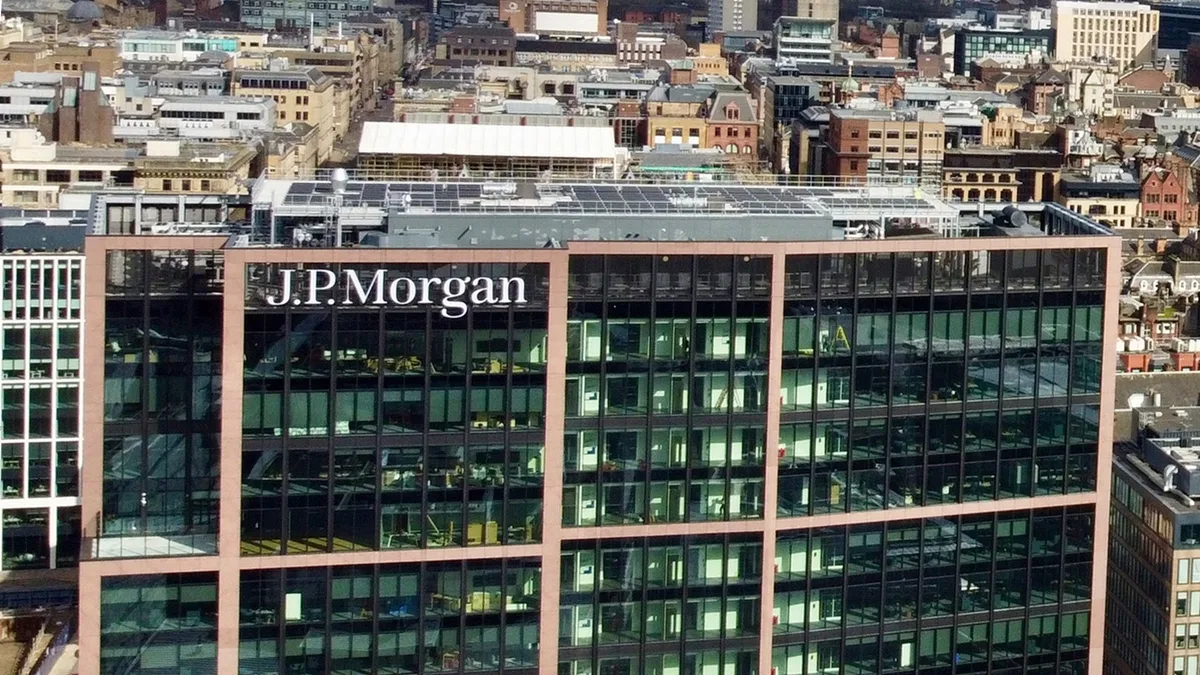
The best example of the strength of the sector is JPMorgan Chase, which has retained the top spot on the Forbes Global 2000 list for the fourth year in a row.
The American banking giant has 4.9 trillion dollars in assets, and in 2025 it generated 9.6 billion dollars in investment banking income, compared to 8.9 billion the year before.
According to Forbes, JPMorgan is the world’s leading investment bank by fees for the 17th year in a row. Among the deals he led was the $1.5 billion initial public offering of CoreWeave, an AI cloud provider – one of the most watched IPOs in 2025.
In other words, while technology companies are developing AI models and infrastructure, banks are making money from financing this wave: advising on takeovers, organizing stock and bond issues, managing IPO processes and trading in increasingly active capital markets.
Dealmaking is back: Mergers and acquisitions jump 36 percent
The great return of the banking sector is particularly visible through the renewal of activities on the market of mergers and acquisitions.
The global value of M&A transactions rose 36 percent in 2025, while investment banking fees reached $102.9 billion. That’s still less than the record $132.3 billion in 2021, but enough to show that the capital market has recovered after a period of more expensive money, investor caution and slowed IPO activity.
For large banks, it is an ideal environment: more takeovers, more IPOs, more securities issues and more trading means more income from fees.
Analysts cited by Forbes estimate that the largest US banks had an almost perfect combination of positive factors: solid credit quality, high net interest income, investment banking recovery, livelier capital markets and a more favorable regulatory environment, reports Investor me.
China’s banks are still huge, but Wall Street dominates
Although JPMorgan tops the overall list, Chinese banks still have enormous balance sheet strength.
Industrial and Commercial Bank of China, with as much as $8.1 billion in assets, remained the second largest bank in the world, but fell from third to sixth place on the overall Forbes list.
Among the highest ranked financial institutions are:
– Bank of America – seventh place overall, with $3.4 trillion in assets
– China Construction Bank – ninth place, with 6.8 trillion dollars in assets
– Agricultural Bank of China – tenth place, with 7.4 trillion dollars in assets
– Bank of China – 12th place, with $5.7 trillion in assets
– HSBC Holdings – 13th place, with $3.3 trillion in assets
HSBC remained the largest bank outside the United States and China.
The US is still the most represented country in the financial category, with 94 companies on the Forbes list. It is followed by China with 66, Japan with 34, India with 18 and South Korea with 17 companies.
Banks are less numerous, but the financial sector is changing
Interestingly, the number of banks on the list dropped from 329 to 314, while the number of diversified financial firms increased from 134 to 136.
This suggests that global finance is changing: traditional banks remain key, but asset managers, holding companies, stock exchange operators, private equity houses, infrastructure funds and companies linked to capital markets are increasingly weighted.
Among the big winners are:
– UBS, which jumped from 64th to 46th place, with $1.7 trillion in assets.
– BlackRockthe world’s largest asset manager, rose from 191st to 172nd.
– Brookfielda Canadian investment company active in the infrastructure, renewable energy, real estate and private equity sectors, jumped 88 places to the 224th position.
– Investor AB, the Swedish holding company with investments in Saab and Ericsson, jumped from 468th to 213th place.
– Intercontinental Exchangethe owner of major stock exchange platforms, rose from 360th to 315th place.
The logic is clear: rising financial asset prices increased the value of asset managers’ portfolios, while higher volatility, more trading, more IPOs and a recovery in the M&A market brought income growth to investment banks and stock market operators.
South Korea among the biggest winners of the AI wave
A particularly interesting part of the Forbes list refers to South Korea, which thanks to memory chips has become one of the biggest indirect beneficiaries of the AI boom.
Korea’s stock market was one of the best in 2025, with growth of 95 percent, and four of the ten biggest jumps in the financial category came from South Korea.
The biggest jump was made by SK Square, an investment company that owns about 20 percent of memory giant SK Hynix. SK Square jumped as many as 837 places, to the 709th position, which is the biggest improvement among companies that were on both last year’s and this year’s list.
Great jumps were also made by:
– SK – growth of 510 places, to the 363rd position
– Mirae Asset Financial Group – an increase of 506 places, to the 782nd position
– NH Investments & Securities – growth of 483 places, to 1,351. position
– DAOU Technology – an increase of 421 places, to 1,220. position
It shows that the AI cycle is not only driven by companies that make software or artificial intelligence models. Chip manufacturers, their shareholders, holding companies, financial institutions and capital markets that are exposed to this growth also benefit.
New players: Industrivarden and Galaxy Digital
The highest-ranked newcomer to the list is Sweden’s Industrivarden, which debuted at number 989. It is a holding company that has concentrated investments in only eight Swedish companies, among which industrial giants Volvo and Sandvik dominate.
Shares in Sandvik rose 52 percent in 2025, thanks to strong demand for mining and industrial equipment, which helped Industrivarden’s net asset value rise 20 percent.
The biggest US newcomer is Galaxy Digital, billionaire Michael Novogratz’s company, which debuted at 1,527. place. Galaxy began as a company focused on digital assets, but expanded the business by purchasing a large bitcoin mining facility in Texas, which was then converted into a data center.
The move shows another important trend: the line between crypto infrastructure, data centers and the AI economy is getting thinner.
Biggest decliners: Argentina and Invesco
Not everyone had a good year.
The biggest decline among the companies that were on both lists was recorded by Argentina’s Grupo Financiero Galicia, one of the largest banking groups in Argentina. The company fell 797 places, to 1,717. position.
Its revenues fell by 30 percent on an annual basis, while its net profit decreased by about 90 percent. A partial explanation lies in the specific Argentinian context: after the drop in inflation and the decrease in yields on government bonds, part of the exceptional incomes that banks achieved in the earlier period could no longer be repeated.
Among US companies, the biggest decliner was Invesco, the asset manager known for the Invesco QQQ ETF. The company fell 365 places, to 1,985. position. Although its shares have nearly doubled over the past year, Invesco has booked a non-cash impairment charge of $1.8 billion in 2025, related mainly to management contracts assumed with the 2019 purchase of OppenheimerFunds.