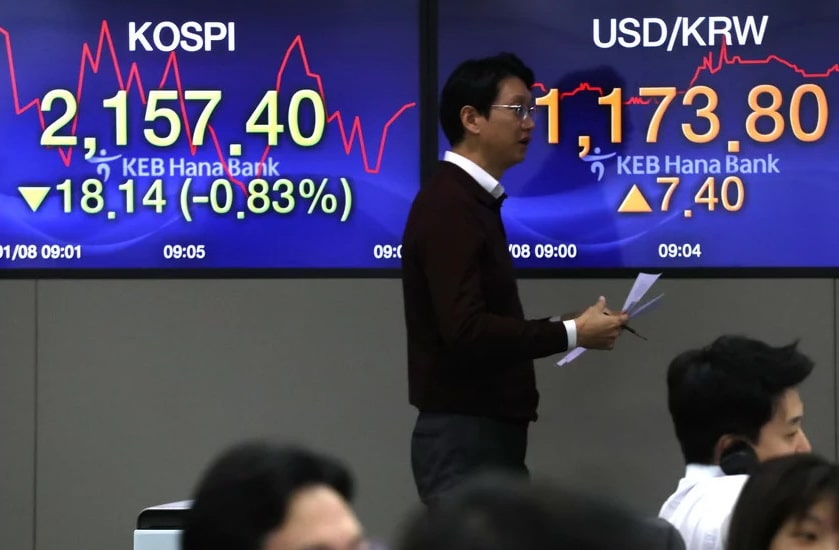
Asia-Pacific markets were mostly lower on Monday as investors weighed renewed US tariffs threats linked to Greenland, raising concerns about escalating trade tensions with Europe.
European countries are reportedly discussing counter-tariffs and broader punitive economic measures in response to new tariff threats from President Donald Trump, further straining relations over Greenland.
Trump announced on Saturday that exports from eight European countries would start at 10% on February 1 and rise to 25% by June 1 if negotiations fail to secure US control of Greenland, a semi-autonomous mineral-rich island under Danish control.
Hong Kong’s Hang Seng index rose 0.1%, while mainland China’s CSI 300 fell 0.26% after heightened regulatory scrutiny following a pick-up in trading activity.
The authorities took measures to curb leverage after onshore market turnover reached record levels, driven in part by a rise in margin trading to record levels.
Despite the tightening, Standard Chartered’s Raymond Cheng said the bank remains positive on China’s A-shares, citing a stabilizing economy and expected fiscal support at China’s upcoming policy meetings in March 2026, SEEbiz reports.
“We think the strength in Chinese equities is sustainable, given the political stimulus that will further boost our projected mid-15s earnings growth over the next 12 months,” said the bank’s regional chief investment officer for Greater China.
Investors are closely watching developments in Japanese markets after Prime Minister Sanae Takaichi said on Monday that she plans to dissolve parliament and call early elections on February 8.
Japan’s Nikkei 225 fell 0.96%, while the Topix fell 0.69%. South Korea’s Kospi rose 0.52% to a record high for the second straight day, while the small-cap Kosdaq jumped 1.78%.
Yields on 40-year Japanese government bonds rose to 4% for the first time.
Japan’s ruling coalition has a one-seat majority in the lower house after it was formed in October, when Takaichi became prime minister after her predecessor resigned. While early elections would increase short-term political uncertainty, they could bring greater policy clarity if a government with a stronger mandate emerges, Fitch Group said in a note.
Fitch expects government debt to remain elevated in the medium term, but to gradually decline as stronger nominal GDP growth compensates for wider fiscal deficits and higher borrowing costs.
Consolidated general government debt is projected to decline to a median of 190% of GDP by FY2029, from an estimated 199.5% in FY2025 and a peak of 222% in FY2020.
Australia’s S&P/ASX 200 lost 0.46%.