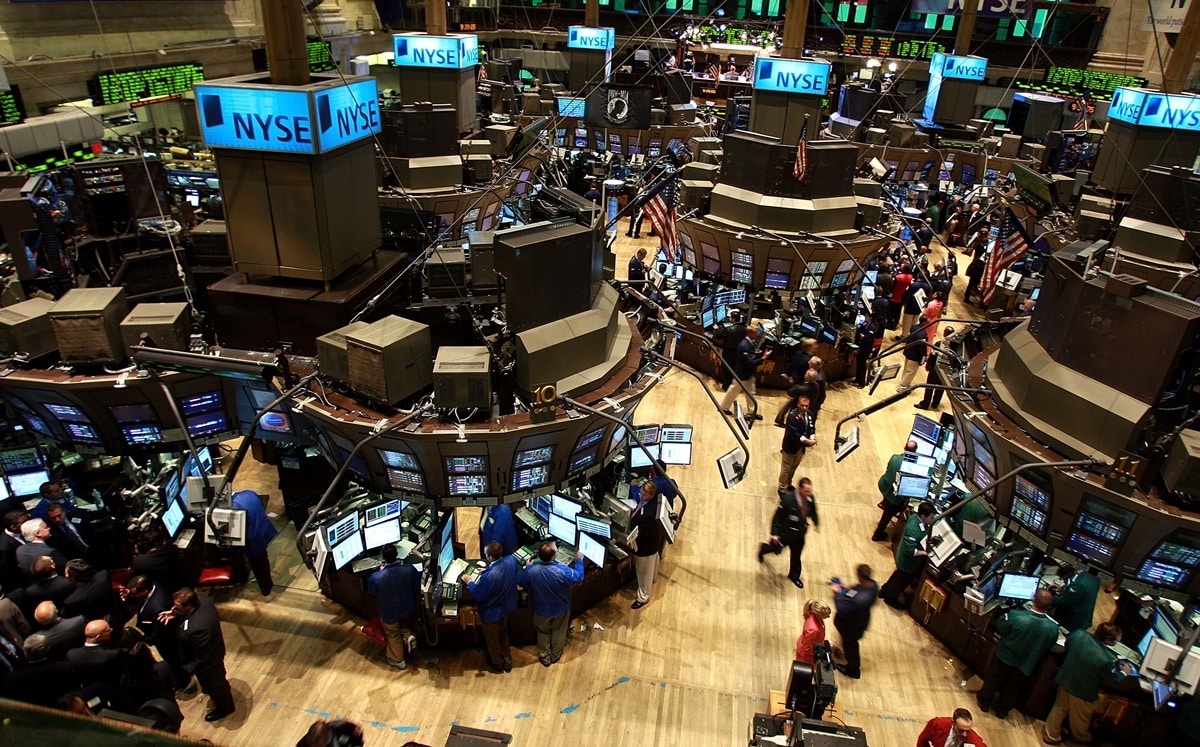
U.S. stocks jumped to their most expensive level against government bonds in a generation, amid growing jitters among some investors over high valuations of megacap technology companies and other Wall Street stocks.
A record run by U.S. stocks, which hit a new high on Wednesday, pushed the so-called forward earnings yield — expected gain as a percentage of stock prices — on the S&P 500 to 3.9 percent, according to Bloomberg data. The selloff in government bonds lifted yields on the 10-year bond to 4.65 percent.
That means the difference between the two, a measure of the so-called equity risk premium, or extra compensation to an investor for the risk of owning a stock, has fallen into negative territory, reaching levels last seen in 2002 during the dot-com boom and bust.
“Investors are actually saying ‘I want to own these dominant technology firms and I’m willing to do it without a huge risk premium,’” said Ben Inker, co-head of asset allocation at asset manager GMO. “I think that’s a crazy attitude.”
Analysts say steep valuations of US stocks, labeled the “mother of all bubbles”, are the result of fund managers seeking exposure to the country’s strong economic and corporate profit growth, as well as a belief among many investors that they cannot risk leaving the so-called Seven magnificent technology stocks from their portfolios.
“The questions we get from clients are, on the one hand, concerns about market concentration and how difficult the market has become,” Inker said. “But on the other hand, people are asking ‘shouldn’t we just own these simply dominant firms because they’re going to take over the world?’
The traditionally constructed equity risk premium is sometimes known as the “Fed model”, as Alan Greenspan seemed to refer to it when he was chairman of the Federal Reserve.
However, the model has its opponents. A 2003 paper by Cliff Asness, founder of fund firm AQR, criticized the use of Treasury yields as an “irrelevant” nominal benchmark and said the equity risk premium had failed as a tool for predicting stock returns.
Some analysts now use an equity risk premium that compares stock returns to inflation-adjusted U.S. Treasury yields. On this reading, the equity risk premium is also “at the lowest level since the dotcom era,” said Miroslav Aradski, senior analyst at BCA Research, though not negative.
The premium might even underestimate how expensive stocks are, Aradski added, because it implicitly assumes that earnings yield is a good proxy for the future real total return on stocks, reports SEEbiz.
With profit margins above their historical average, if they “returned to their historical norms, earnings growth could end up being very weak,” he said.
Some market watchers are looking for completely different measures. Aswath Damodaran, a finance professor at New York University’s Stern School of Business, sharply criticized the Fed’s model and said the proper way to calculate the equity risk premium is to use cash flow expectations and cash payout ratios.
According to his calculations, the equity risk premium has decreased over the past 12 months and is close to a 20-year low, but “definitely not negative.”
The valuation of stocks relative to bonds is just one measure of exuberance reported by managers. Others include evaluating the price of US stocks relative to their own history or comparing them to stocks in other regions.
“There are a lot of red flags here that we should be a little bit cautious about,” said Chris Jeffery, head of macro at Legal & General’s asset management division. “The most disturbing difference is the way US stocks are priced versus non-US stocks.”
Many investors argue that high multiples are justified and can be sustained. “It is undeniable that it is a multiplier [cijena-zarada američkih dionica] high relative to history, but that doesn’t necessarily mean it’s higher than it should be, given the underlying environment,” said Goldman Sachs senior equity strategist Ben Snider.
According to Goldman’s own model, which suggests what the PE ratio should be for an index of U.S. blue-chip stocks, after taking into account the interest rate environment, the health of the labor market and other factors, the S&P is “in line with our modeled fair value,” he said. Snider.
“The good news is that earnings are rising and, even with unchanged estimates, earnings growth should boost share prices,” he added.
US stocks have now regained all that was lost during the decline since December. That selloff highlighted concerns among some investors that there is a level of Treasury yields that the stock market’s rise can’t live with, because bonds — the traditional safe-haven asset — would seem so attractive.
Pimco’s chief investment officer said this week that the relative valuations between bonds and stocks are “about as wide as we’ve seen in a long time.”
For others, the decline in US equity risk premiums is just another reflection of investors piling into Big Tech stocks and the risks that concentration in a small number of big names poses to portfolios.
“While momentum on the Mag 7 is strong, this is the year you want to diversify your stock exposure,” said Andrew Pease, chief investment strategist at Russell Investments, referring to seven major tech stocks.biz.