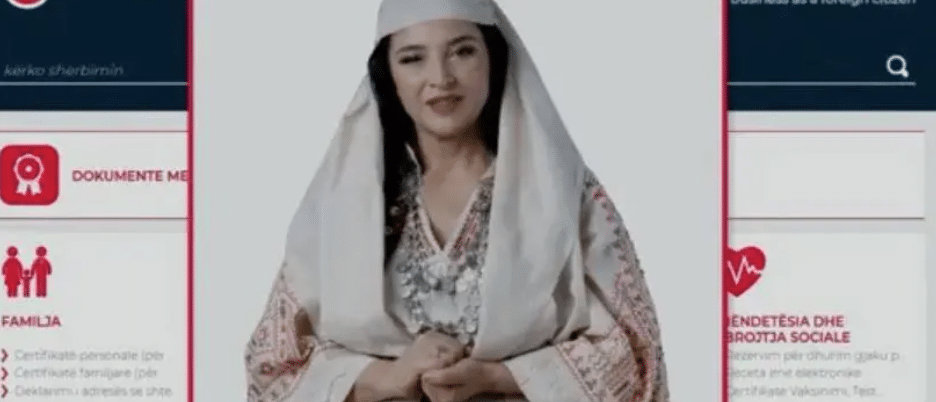
The AI avatar Diella, a symbol of the fight against corruption in Albania, has found itself at the center of a scandal after an investigation against the agency that developed it.
Avatar named Diellapresented as the first female minister in the world created with the help of artificial intelligence, was supposed to be one of the tools in the fight against deep-rooted corruption in Albania. However, the project found itself at the center of controversy after the managers of the state institution that developed Diella were linked to corruption scandals, it is written The New York Times.
Diella was presented to the public as a symbol of Prime Minister Edi Rama’s reform course at a time when Albania is intensifying its efforts to join the European Union. Dressed in traditional costume and with a recognizable smile, she appeared at international gatherings and was strongly promoted in the media as proof of the introduction of artificial intelligence into key segments of society, including state administration.
During last autumn, she also addressed the representatives in the Albanian parliament, when she stated that she felt “hurt” because of criticism that her activities to detect abuses and fraud in public procurement are unconstitutional, because she is “not a human being”.
In one of the video addresses from September, recorded with the Albanian and European flags, Diella said that she has no personal ambitions or interests, but that she acts solely on the basis of data, knowledge and algorithms, with the aim of impartial, transparent and continuous service to citizens.
In practice, Diella allows citizens to submit requests for government services online, which seeks to eliminate the long-standing practice of bribing officials for faster processing of documents and scheduling of appointments.
The fight against corruption represents one of the key conditions on Albania’s path to membership in the European Union and is one of Prime Minister Rama’s central political promises. The name Diella, which means “sun” in Albanian, was chosen to symbolize transparency, especially in the field of public procurement.
In an interview, Rama stated that it is difficult to establish a completely fair and transparent system in a country with strong “kinship ties”, but he assessed that the reforms started after he came to power in 2013 brought significant progress. He also announced his withdrawal from politics after Albania’s entry into the European Union, which, according to the current dynamics of negotiations, could take place around 2030.
In the European Union report from November, it was stated that Albania has made some progress, but that corruption is still widespread, especially in sensitive sectors. The Special Investigative Office, established in 2019, which recorded concrete results in the prosecution of high-level corruption, was especially praised.
House arrest for agency leaders
Among the current investigations is the one against the National Information Agency, the institution that developed Diella. Last month, the prosecution placed the director of the agency and her deputy under house arrest on suspicion of being connected to a criminal group that, according to the investigation, manipulated public tenders through threats and intimidation. Although the indictments have not yet been filed, Prime Minister Rama said that it is necessary to wait for the final results of the investigation.
Meanwhile, the Special Investigation Office has significantly expanded its activities against corruption and organized crime, including proceedings against former President Ilir Meta, Tirana Mayor Erion Veliaj, as well as Minister of Infrastructure and Energy Belinda Balluku, a close associate of the Prime Minister.
Effects of Diella’s work
It is not possible to give a precise assessment of the real impact of Diella’s system on reducing corruption, given that it was primarily designed as a preventive mechanism, not a tool for detecting illegality.
Andi Hoxhaj, an expert on law and the Western Balkans from London’s King’s College, estimates that Diella Rama allows the European Union to show that it is aware of the problem of corruption and that it is taking steps to solve it. The analysis of the German Council for Foreign Relations states that the application of artificial intelligence has contributed to greater efficiency and impartiality in decision-making on public procurement, but points out that Albania’s overall results in meeting EU standards still remain insufficient.
Accusations against the very institution that manages Diella also opened up the dilemma of the possibility of artificial intelligence being programmed to ignore certain evidence or rely on unreliable data. However, according to experts, the fact that the case was exposed and not covered up indicates that the authorities recognize the scale of the problem, he says. Morning paper.
(TYPE/Source: Jutarnji list/Photo: X)