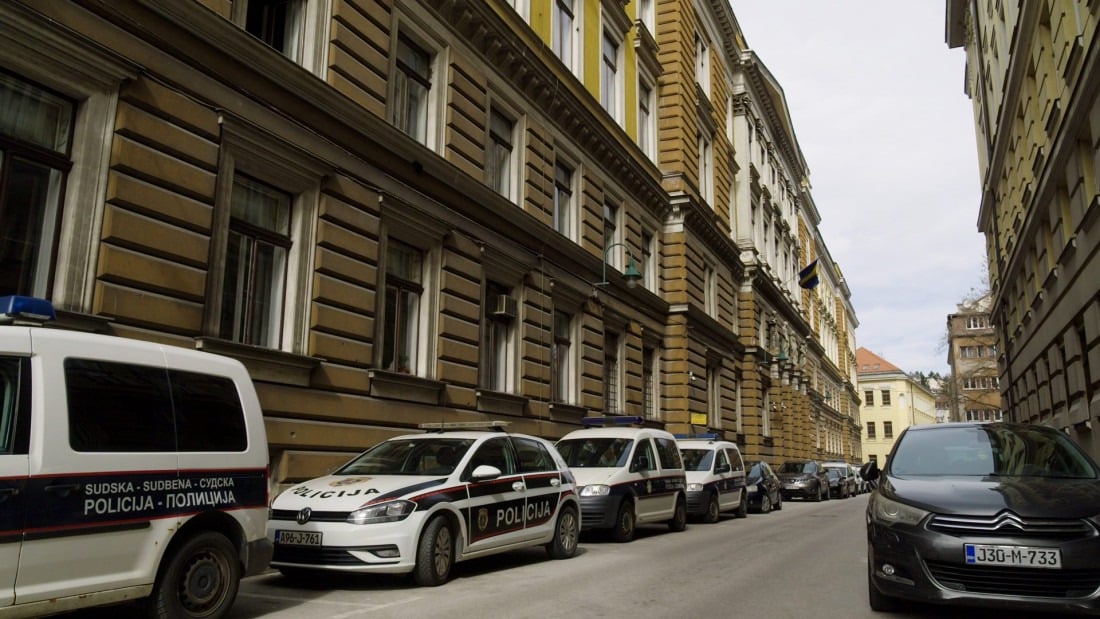
With the reading of the indictment in the Sarajevo Cantonal Court, the trial of Jasmin Mešković, the former president of the Union of Prisoners in Bosnia and Herzegovina, and others for abuse of position or authority related to the sale of duplicate museum tickets in Sarajevo and Mostar began.
In addition to Mešković, Suada Nožić, Senad Jusufbegović, Midheta Šoljić, Šejla Bašić, Menvirsa Kmetaš-Demić and Senad Muhović are accused, and they are also charged with conspiracy to commit criminal acts.
Mešković is charged as the president of the Union of Detention Centers of Bosnia and Herzegovina and deputy president of the “Bosnian Museums of Remembrance” Association, and a member of the Assembly of the Association, Nožić as the president of the Association, and Jusufbegović as the president of the Association’s Assembly. According to the indictment, Šoljić and Bašić were engaged in, among other things, selling tickets at the Museum of Crimes Against Humanity and Genocide in Sarajevo, and Kmetaš-Demić and Muhović were also engaged in these tasks, among other things, at the Museum of Victims of War and Genocide in Mostar.
They are charged that, as members of the joint group and helpers of other members, in the period from July 2017 to mid-December 2019, by purchasing and selling at least 21,588 pieces of tickets in both museums, the proceeds of which they kept for themselves and divided among themselves in a manner known to them, obtained illegal property benefits for themselves and others in the amount of at least 148,328.94 KM.
According to the indictment, which was read by the prosecutor Zoran Ikonić, in the second half of 2017, Mešković devised a plan for the purchase and sale of so-called double tickets, in parallel with the sale of officially ordered tickets, with the fact that the turnover from the sale would not be recorded in the business books, but the money obtained from the sale would be separated separately.
Mešković, as stated, during June and July 2017 orally informed the members of the group Nožić, Jusufbegović and Šoljić about the mentioned plan, telling them that the Museum in Sarajevo will start with the purchase and sale of duplicate tickets, that the income from them will not be shown in the bookkeeping records and that the money from the sale will not be deposited in the bank account.
According to the indictment, after the establishment of the Museum of Victims of War and Genocide in Mostar in July 2018, Mešković and Nožić informed Kmetaš-Demić and Muhović, who were selling tickets at the Museum in Mostar, about the aforementioned plan, which also informed them that the revenue from the sale of tickets would not be shown in the bookkeeping records, that the money from the sale would not be deposited into the account, but that it would be placed in envelopes, which Mešković would occasionally come for and Knife. It is also stated that from the middle of 2018, the purchase and sale of duplicate tickets also began in the Museum of Victims of War and Genocide in Mostar.
As stated in the indictment, Mešković and occasionally Jusufbegović procured in an unspecified manner from an unknown supplier, and sometimes from a printing house, tickets that were mostly marked with double serial numbers as well as officially ordered tickets, and which were then distributed by Nožić and Jusufbegović during the rebellions of Šoljić, Bašić, Kmetaš-Demić and Muhović. The four of them worked on the sale, “with a note to the ticket sellers that these are double tickets, that they are sold alongside the officially ordered tickets at a price of eight KM or ten KM, and that the proceeds from the sale of those tickets are separately separated into envelopes, and that no written record will be kept of the sale of those tickets, as was kept by the sellers for official tickets, which they did”.
Mešković, Nožić, and occasionally Jusufbegović took the envelopes from the seller, as Ikonić read.
According to one of the counts of the indictment, Mešković, Nožić, Jusufbegović, Šoljić and Bašić, from July 2017 to April 2018 and November 5, 2019, at the Museum of Crimes against Humanity and Genocide in Sarajevo, by purchasing and selling at least 9,183 tickets, the proceeds of which they kept for themselves and divided among themselves in a manner known to them, obtained for themselves and others illegal property benefits in in the amount of at least 87,388 KM.
According to the statement, from April 2018 to mid-December 2019 at the Museum of Crimes against Humanity and Genocide in Sarajevo, they procured and sold at least 5,335 pieces of double tickets, the proceeds of which they kept for themselves and divided among themselves in a manner known to them, obtained illegal property benefits for themselves and others in the amount of at least 51,450 KM.
It is also added that, although she was warned not to, without the knowledge of the other members of the joint group, from April 2018 to mid-December 2019, in several notebooks, Šoljić kept a handwritten record of the sale of double tickets for the days and shifts when she was working on sales duties, stating the exact date, serial number and number of tickets sold, and the amount of sales made in her shift, which was also read as part of the indictment.
Nožić is charged with using her powers to knowingly not register the money from the sale of those tickets anywhere or handing it over to the bank, and that Jusufbegović, as the president of the Assembly of the Association, knowingly failed to exercise due supervision over the lawful use and disposition of income from the sale of tickets.
The prosecution will continue to read the indictment and present its opening statement at the hearing scheduled for December 18, reports BIRN BiH.
(TYPE/Source: Detektor.ba)