… brings a selection of photographs taken during the siege of Sarajevo from 1992 to 1995, which through documentary and artistic expression bear witness to the everyday life, suffering and dignity of citizens in wartime circumstances.
The author of the exhibition, Rikard Larma, one of the most important Bosnian photographers and photojournalists, said that the photographs were taken during the siege of Sarajevo from 1992, noting that the photographs now on display were taken as late as 1995.
He also added that for this exhibition he included several photographs taken during the period of his work at “Oslobođenje press”.
He noted that the photos were previously presented abroad, stating that they were printed in Italy and that a large exhibition with those works was organized in Padua.
He pointed out that the original exhibition contained about 70 photographs, which were selected by Abdullah Sidran, who also wrote the introductory text for the first exhibition of its kind held in Sarajevo during the war, in the Chamber Theater 55.
– I came to journalism as a young photography artist through Photo Association and photo amateurism, and my guiding principle was to show what is happening in an artistic way. And in these photos I saw exactly that – pointed out Larma.
The author of the exhibition said that even before the end of the war, he thought about the fact that the photographs created would remain a permanent testimony of the events of that period and that he felt a responsibility to preserve them so that they would remain available to future generations and that what happened would not be forgotten.
– However, it happened that I didn’t live in Sarajevo afterwards. So others took up the job of being the bearers. I am now continuing it by publishing my magazine, and I am also working on publishing a book – said Larma.
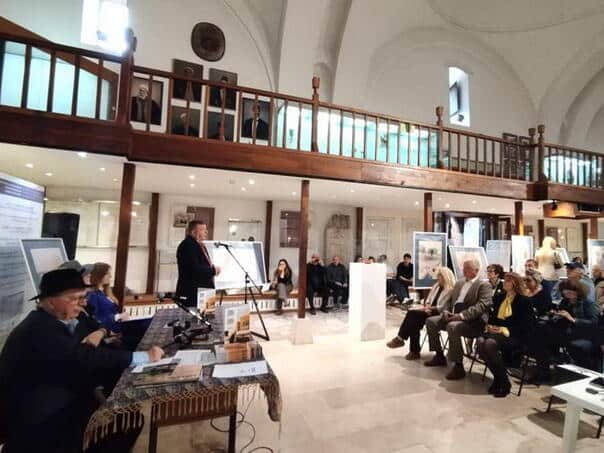
The director of the Archives of the Federation, Hajrudin Ćuprija, addressed those present, who said that before us is an exhibition for which it was very difficult to make a selection from among hundreds and even thousands of photographs.
– It was difficult to choose 30 photos, and each photo has a separate story. We made a selection of photos that tell about what happened in the period 1992-1995. year. We called it “Life” because in the pictures you can see the life of people in besieged Sarajevo – said Ćuprija.
He pointed out that it is important to preserve this kind of documentation and stated that it is a special honor for him that an agreement was signed with the author according to which a collection of photographs will be handed over to the Archive of the Federation for permanent preservation.
– In this way, the photograph will become eternal, as well as the author who took those photographs. They are not only documents of a time, they are a testimony to the courage, dignity, suffering and suffering of a people – he stressed.
Ćuprija assessed that art shows its greatest value and purpose precisely in difficult times and pointed out that these photographs played a significant role in a period when it was not possible to disseminate accurate information about the events in Sarajevo.
He reminded that, thanks to the publication in major world media such as the Associated Press and other international media houses, the photographs represented a kind of conscience and a reminder to the international public and power centers of the events in Sarajevo.
The director of the Museum of Sarajevo, Indira Kučuk Sorguč, said that this institution has been cooperating for many years with the Archive of the Federation precisely on documenting the memory of the history of tragedies in BiH and all those topics that historians should research and present.
In her address, the director explained that there is a difference between the culture of memory and the culture of memory, stating that the culture of memory implies a personal and subjective experience of past events and historical moments, while the culture of memory represents the institutional preservation of historical facts, evidence and documentation.
– That is why it is very important that we photographically document what happened in this way and that we do not deviate in any way from what is most important, which is the truth – she underlined.
She said that the past should not be forgotten and emphasized the importance of institutions that preserve the facts and testimonies of survivors, as well as individuals who contributed to the preservation of collective memory through their work.
As an example, she cited Rikard Larma, who she said was on the streets of Sarajevo during the entire period, saved photographic material and later digitized and processed it, giving an artistic and documentary stamp to everyday life in the besieged city.
The exhibition is organized by the Archive of the Federation in cooperation with the Museum of Sarajevo.
As part of the opening, the promotion of the magazine/photo-archive/photo-museum “Rikard LRM” will be held.
(Vijesti.ba / FENA)