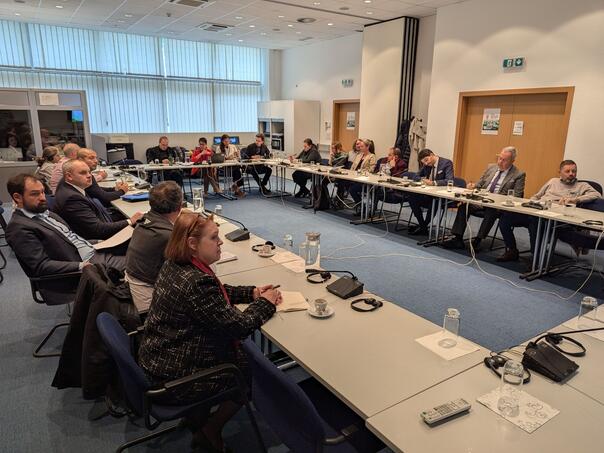
Zoran Pola Poleseca from the ecological association “Ozrensko Studenac” Doboj and Snežana Jagodić vujuć was spoke about the planned njerveni and cobalt exploitation projects. Davor Šupuković also presented his observations from the Association of Citizens “Fojničani” Maglaj Te Tihomir Dakić from the Center for the Environment Banja Luka. Representatives of the European Union presented Critical Raw Materials ACT, emphasizing that the exploitation of critical minerals in Bosnia and Herzegovina should be implemented in accordance with the same standards and practices that are valid in the Member States of the European Union.
However, the present environmental activists pointed out that they do not see the same enthusiasm of the European Union when it comes to nature protection standards. While the European average of the protected territory is 26%, in BiH, this share is only 3%, which activists assessed alarming and completely unacceptable.
Ecological associations have emphasized that they understand the EU’s global priorities in ensuring alternative sources of critical mineral resources, but cannot accept a passive attitude towards achieving nature protection standards in BiH. They therefore requested a resolutely partnership with the European Union in harmonizing environmental protection standards, because from domestic corrupt authorities do not expect any support.
Ecological activists also emphasized that the issuance of permits for mining projects in BiH is not based on European standards, but in domestic laws that are obviously changing to investor interests. This is best seen in the change in the Law on Detailed Geological Research of Republika Srpska, where the local community is excluded from decision-making, which is a direct violation of the Aarhus Convention. Activists pointed out that this problem passed completely unnoticed in the EU circles, further collapse of citizens in European institutions.
The example of a mine in Vareš, owned by the British-Australian company, illustrates it is pictorially illustrated as the mining of critical minerals in BiH is currently looking. For everything quarter and a half of the silver, copper, cycles and other metals, the company will generate about 41 million KM, while the concession fee paid to Zenica-Doboj Canton, only 276,900 KM, or 0.68%. Activists have set up a clear question: Is there such a low concession fee in the world? Why did the EU never express concern about such fees that are below all standards, especially those European ones?
Civil society organizations that struggles to protect nature have emphasized that they have been led by the example of inter-entity cooperation for years. However, although the European Union is precisely such cooperation declaratively encouraging, this positive example did not encounter significant support. On the contrary, they point out that the only support that CSOs had via the OSCE Mission made up early this year closing the field office in Maglaj.
What further worrys of environmental organizations is that foreign companies in BiH act in a similar way as domestic authorities, using division and emergence of hate to achieve their interests. This behavior creates new security risks and endangers the efforts of environmental organizations that are building bridges and communion for years.
Due to all the above, the citizens of Bosnia and Herzegovina are increasingly experiencing the situation as a collective conspiracy, which are connected by domestic authorities, foreign companies and the High Representative – all on one side, the citizens themselves, left to their own struggles for protection. Environment, human rights and dignity, concluded CSO representatives at the meeting in Sarajevo.
(Vijesti.ba)