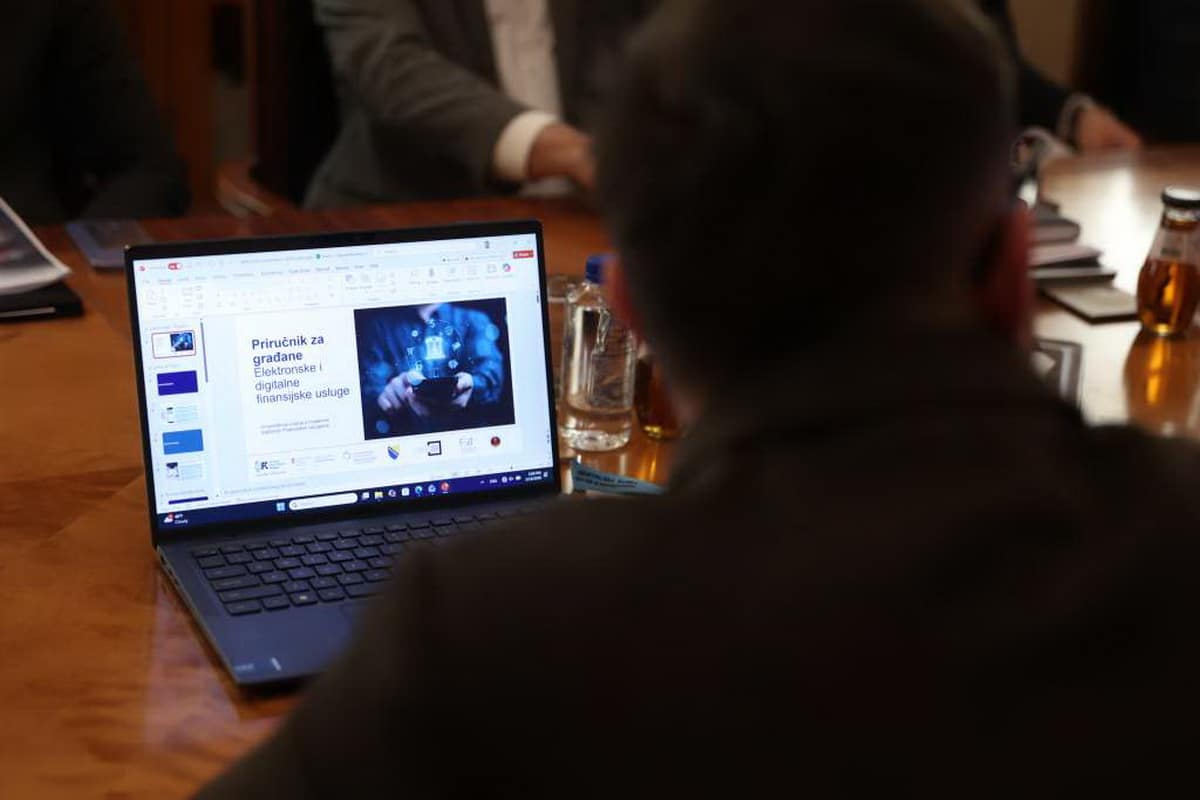
The Central Bank of Bosnia and Herzegovina (CBBH) in cooperation with the International Finance Corporation (IFC) has created a Handbook for citizens on electronic and digital financial services that will help them navigate the increasingly dynamic digital financial environment and use the services available to them with more confidence.
The manual, which was presented at the CBBH in Sarajevo, covers topics that are now an integral part of everyday life, from digital payment channels, use of cards, internet and mobile banking, to electronic wallets and security in the digital space. Special focus was also placed on modern payment systems, including instant payments and the SEPA area.
Vice Governor of the Central Bank of BiH, Emir Kurtić, said that recognizing the needs of the general public, in cooperation with the IFC, with the support of SECO, and together with partners from entity banking agencies and the Association of Banks of BiH, they prepared an educational manual that was not created by chance.
– It was created in response to specific questions that we receive from citizens every day. Citizens often ask us: does the introduction of modern payment systems and accession to the SEPA area also mean the introduction of the euro? How do instant payments work? How secure are digital transactions? And perhaps most importantly – how to protect yourself from fraud in the digital environment? We tried to give clear, comprehensible and practical answers to those questions – said Kurtić.
The head of the IFC office for BiH and Montenegro, Armin Ridžalović, said that the new manual is an important tool for strengthening financial literacy and inclusion of citizens.
– The transition from cash to digital payment channels causes fear for many citizens. We fear what we don’t know. This manual is here to clarify unknowns and facilitate the transition to digital services that await us in the coming months and years – said Ridžalović.
He noted that financial literacy is not a technical issue, but rather the foundation of broader financial inclusion of all citizens in the modern financial system. Ridžalović confirmed that IFC remains committed to supporting the Central Bank of Bosnia and Herzegovina, including processes related to access to SEPA and further development of digital financial services.
The manual was promoted as part of the OECD Global Money Week, a global financial education campaign coordinated and actively implemented in Bosnia and Herzegovina by the Central Bank of Bosnia and Herzegovina. This is precisely why this year, through a series of activities, they paid special attention to young people. During this week, they hosted more than 400 students from all over BiH, with the aim of strengthening their financial literacy and understanding the importance of smart money management under the motto, “Smart Money Talks”.